Sunday, June 04, 2023
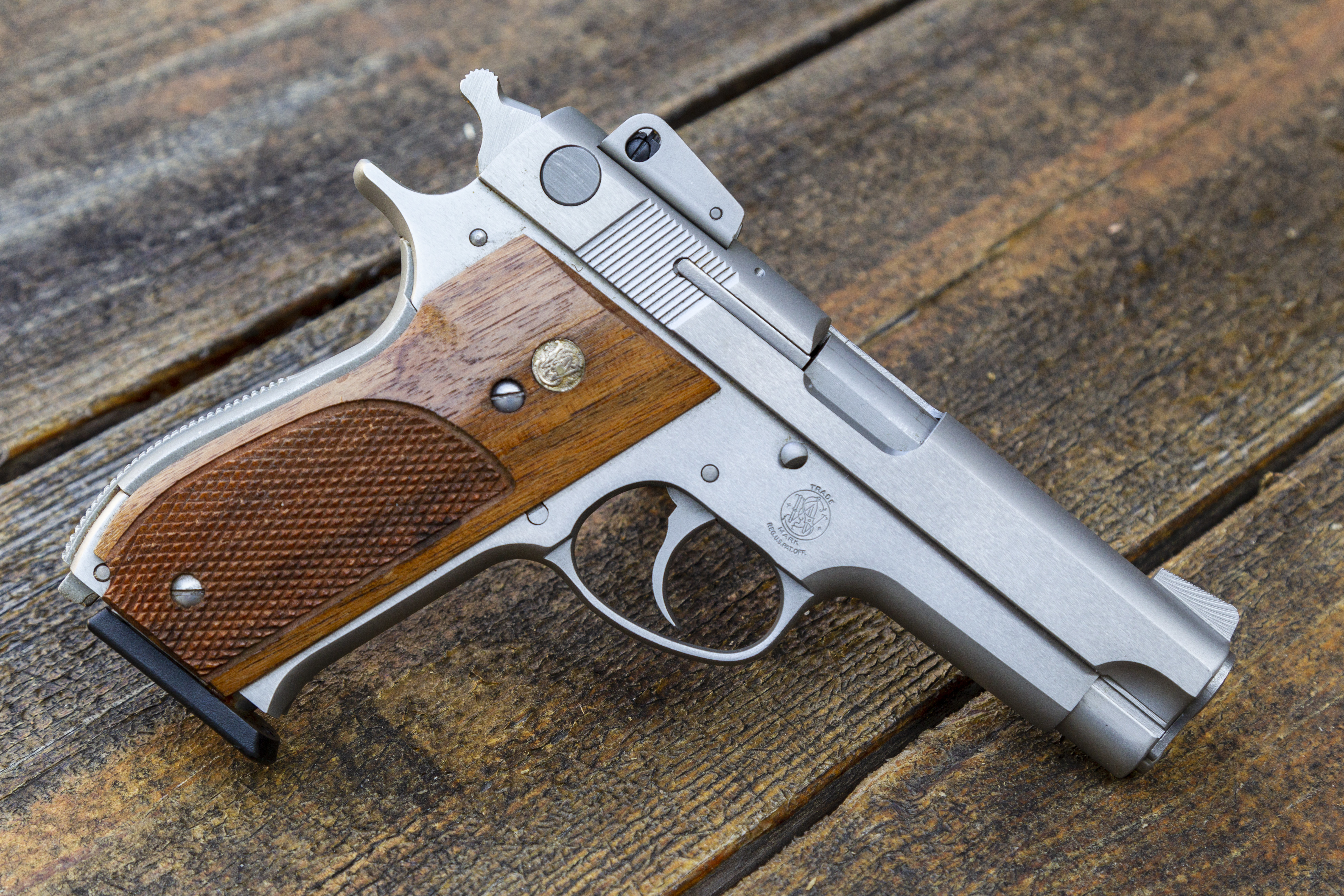
Sunday Smith #73: Model 639, 1984
Thursday, November 11, 2021
Sunday, Savage Sunday #5...
![]() |
| Advertisement from June, 1914 issue of National Geographic |
Sunday, October 24, 2021
Sunday, Savage Sunday #4...
Sunday, October 17, 2021
Sunday, Savage Sunday #3...
![]() |
| Savage for Victory! |
Sunday, October 10, 2021
Sunday, Savage Sunday #2...
The trigger is still case-colored and it still has the early version of the burr on the cocking piece as well as the very wide slide serrations. The grips on this example are in very good shape, with the "TRADEMARK" lettering still legible on the chief's headdress.
Tuesday, February 09, 2021
I-Frame Details, Part One
The 2nd Model went through five successive engineering changes from 1903 until production was suspended for the Great War. When it came back in 1919, the new guns were referred to as .32 Hand Ejector, 3rd Models. The lower revolver in the picture above is a 3rd Model with a serial number placing its date of manufacture probably somewhere in the 1920s.
Sunday, November 01, 2020
Sunday Smith #68: PC Model 4513 Shorty .45, 1996
When Smith & Wesson got back into the centerfire autoloader game about a decade after WWII, they only offered the pistol in one chambering. They could call it the "9mm" because in 1955 it was the first commercial domestically-produced autoloader purposely designed around the 9x19mm cartridge (Colt's contemporaneous 9mm Commander was just a Government Model with an alloy frame and three quarters of an inch whacked off the barrel.)
When Smith shifted from romantic model names to prosaic model numbers in 1957, the 9mm pistol became the "Model 39". Through the first generation of Smith's modern hammer-fired autos and well into the second, the self-loading pistols were only offered in 9x19mm*.
In fact, it wasn't until 1985, nearly at the end of the era of the three-digit Second Generation autos that Smith released one in something other than 9mm: The Model 645, a double-action challenger to the Colt Government Model. It was a honkin' big pistol with a DA trigger, hammer-dropping safety, five-inch barrel, and a size and bulk that actually slightly overshadowed the classic 1911.
After only a couple years' production, the Third Generation autos supplanted the Second in 1988. The Model 4506 was the full-size replacement for the Model 645, and it was joined in the catalog in 1990 by the Model 4516. The 4516 had a 3.75" barrel and was obviously intended as a compact challenger to Colt's diminutive Officer's ACP, which had hit the streets in 1985.
The problem was that, being constructed entirely of stainless steel, the 4516 was brick heavy at nearly thirty-eight ounces.
Enter the Performance Center, in those days still helmed by Paul Liebenberg and functioning as a limited production hand-built custom shop. In 1996, a small run of "Shorty .45" pistols were sold through distributor Lew Horton, capitalizing on the success of earlier runs of Performance Center Shorty .40 guns.
SKU #170075, labeled as a "4513" on the box, was a 3.5" single stack subcompact .45ACP. It had a hand-fitted titanium barrel bushing, hand-fit frame and slide, hand-tuned action, single-sided hammer-dropping safety, and 7-round magazine. Unlike the similarly-sized 4516, it had an alloy frame with 20lpi checkering on the frontstrap, and this difference between the two pistols knocked a full ten ounces off the gun's weight. The pictured example weighed just over 27oz. on my postal scale.
Lew Horton ordered 662 of the Shorty 45's in 1996 and they had an MSRP of $1145.95. The pictured example was bought in 2020 in used condition in the original Doskocil case with two magazines at my local gun store for $550.
*Well, and .38 Special... Hopefully I'll someday be able to do that Sunday Smith!
Sunday, October 25, 2020
Sunday Smith #67: PC Model 4006 Shorty .40 Mk3S, 1996
Just titling this post was difficult. You'll see this gun referred to by a bunch of different names, with "Shorty Forty" or "Shorty .40" being the most common. Hardly ever is it acknowledged as a Model 4006 variant, which is what Smith calls it on the label on the side of the case.
Sunday, October 18, 2020
Sunday Smith #66: Model 1066, 1991
The history of the 10mm Auto cartridge is well-documented elsewhere (and has been lightly touched on here) but basically it was the culmination of an effort to make an ideal cartridge for a fighting pistol, shooting flatter and further than the .45 and hitting harder than the 9x19mm.
Unfortunately, the pistol with which it had been developed hand-in-glove was a flop, victim of undercapitalization, manufacturing glitches, and poor sales. With the Bren Ten a failure, the cartridge might have sunk below the waves alongside it, had not Colt launched the Delta Elite, a 1911 chambered in 10mm Auto, in 1987.
Two years later, Smith & Wesson launched the Third Generation variant of their large-frame .45ACP single stack auto in the shape of the Model 4506, and with that groundwork laid, 1990 saw Smith's first 10mm Auto offerings, based on the same frame.
The full-size version, dubbed the 1006, was joined in the catalog with a 4.25" barreled variant, the Model 1066.
With its 4.25" barrel length, 39 ounce weight, and $730 MSRP, the Model 1066 was nearly an overlay for a Colt's Combat Commander in stainless, albeit with a double-action trigger, an ambidextrous safety/decocker, and chambered for the new hotness 10mm Auto.
Production of the 1066 ended after only three years, with 5,076 built from 1990-1992.
The above example, in clean shooter-grade condition with long-dead factory night sights and an aftermarket Hogue grip, was purchased (with one magazine and no box) in 2020 for $500.
.
Sunday, August 02, 2020
Sunday Smith #64: .38 Safety Hammerless Third Model, 1893
As was mentioned the last time we looked at a .38 Safety Hammerless on this blog ('way back in Sunday Smith #2), the commonly repeated origin story of these handguns is probably largely hooey.
Gun shop mythology has D.B. Wesson hearing a tale of tragedy, this time of a young girl getting ahold of daddy's revolver and managing to shoot herself after cocking the hammer. Thus motivated, he sat up that night until the design of the Safety Hammerless sprang fully formed, Athena-like, from his furrowed brow.
In reality, regardless of the actual impetus behind the design, the revolver itself was one of the younger Joe Wesson's first projects at S&W, and passed through two iterations of drawings in 1882 and 1884 before appearing for sale in its final form in 1886.
The pictured revolver is the third iteration of the model. It had gone from a complex "Z-bar" latch holding the frame closed to a simpler push-button one. The hammer was locked in place while the latch was being operated, which added redundancy to the grip safety.
Production of the Third Model started at s/n 42,484 in 1890 and ran through s/n 116,002 in 1898, putting the pictured revolver, with a serial number in the mid 60,000's, somewhere in the early half of that range. In the absence of a factory letter, I'll spitball it at 1893.
It was replaced by the Fourth Model, as seen in Sunday Smith #2, which had a sturdier and more easily operated, yet equally simple to manufacture, "T-bar" toggle frame latch.
With seventy-some thousand built, the Third Model is the second most numerically common variant after the Fourth Model.
The thumb latch had to be pushed down to unlatch. It takes a while to get to where you can do this gracefully without trying to hold the gun shut with your thumb while your other hand is trying to open it. Note that the latch, as well as the spring in the topstrap, is blued on this nickel gun.
That little lip at the top of the square recess is the entirety of the locking surface holding the gun closed. Worn guns may pop right open when fired, which can be exciting.
The front sight on the Third Model, as on the First, Second, and Fourth Models, is pinned to the rib atop the barrel. The front sight on the Fifth Model was an integral part of the barrel.
While the trigger retains only vestiges of case coloring, the bluing on the trigger guard is still fairly nice. Looking to see if these areas are still in their original colors is a good first indicator of a re-nickel job. (See again the .38 Safety Hammerless Fourth Model in Sunday Smith #2). The mother-of-pearl grips are nice, but I do not believe them to be the factory stocks.
.
Sunday, March 26, 2017
Sunday Smith #56: Model 2206, 1996
They got there by taking the basic design of the Model 61, which itself was derived from a long gone Belgian pocket auto, and stretching the barrel and butt into a 10-shot target pistol available with either a 4.5" or 6" barrel, called the Model 422.
Debuting in 1987, the 422 was soon joined by a version with a stainless slide and clear-coat anodized aluminum frame, which in keeping with current S&W numbering practices was the 622. (The number "6" being, generally, a S&W designator for stainless steel. Like most languages, S&W model numbers are best learned by immersion and osmosis rather than from a dictionary.)
Just as these guns were hitting the market, the centerfire S&W pistol world was transitioning from the "Second Generation" guns with their three-digit designators to the "Third Generation" autos, which bore four-digit model numbers. Perhaps with an eye to that, when the all-stainless version of the rimfire plinker debuted in 1990, it was designated the Model 2206.
The six-inch version of the 2206, pictured above, hit the market with an MSRP a whisker under $400 in 1990. It's a hefty gun, weighing in at an honest 39 ounces, which is, like, M1911 heavy. Recoil is pretty much non-existent. Even high-velocity loads are practically like shooting an airsoft gun.
This whole line of pistols was never really a sales threat to the dominant Ruger autos and were superseded in the late 1990s by the much simpler to build Model 22.
The pictured gun, featuring an aftermarket threaded barrel, was purchased from an internet friend for a little over three bills in 2016. Standard Catalog of Smith & Wesson, 4th Edition says $275 for EXC and $225 for VG and add $40 for adjustable sights. An ANIB example configured like the one above (less aftermarket barrel) would book at $390 w/box & docs in the SCSW4E.
.
Monday, March 13, 2017
Sunday Smith #55: Model 745, 1988
One place it had difficulty making inroads was in the growing sport of action pistol shooting, where customized 1911-pattern guns from Springfield and Colt ruled the day. So based on some custom work done on personal guns by their in-house gunsmiths, Smith & Wesson released a competition-oriented variant of the Model 645, dubbed the Model 745.
The initial run came with the serial number prefix "DVC", for the IPSC motto of "Diligentia, Vis, Celeritas", or "Accuracy, Power, Speed". They also had special IPSC 10th Anniversary engraving on the slide.
The guns featured special Novak sights and a single-sided safety with enlarged paddle-like shape. Note that, unlike conventional S&W autos, depressing the safety does not drop the hammer. This is because the 745 borrows from the lockwork of the similarly competition-oriented Model 52 .38 Wadcutter gun and is single-action only.
The slide release is enlarged in a fashion similar to the safety, and the magazine release features an oversize button as well. There's an overtravel stop set in the frame behind the trigger, and checkering on the front- and backstraps.
Its parent gun, the 645, was discontinued in 1988, replaced by its Third Generation successor, the Model 4506, but the 745 continued in production for another couple years before being discontinued as well. Its own successors, the Model 845 and 945 came from the then-new Performance Center.
The gun in the photos was acquired at a gun show in Louisville, Kentucky in early '17 for $700.
.
Monday, November 21, 2016
Pocket Pistols...
The classic offerings all weigh in at around 12-13 ounces empty, with the Harrington & Richardson being lightest and the Colt at the heavier end of the trio. Despite being a recoil-operated .380 instead of a simple straight-blowback .25, the Ruger was almost two ounces lighter than the lightest of the older guns.
Like the LCP II, the H&R and the Steyr Pieper are hammer-fired, while John Browning's vest-pocket Colt 1908 is a striker-fired gun. While the LCP II has small sights for a modern arm, they look like target Bomars when compared to the vestigial nubbins on the Steyr and Colt. The H&R, on the other hand, has not even the faintest suggestion of anything sight-like to mar the smooth upper curve of the slide and barrel.
I rifled my ammo storage and other than a box of Gold Dots in 1990's-era packaging and half a blister pack of Glasers that probably date to Bill Clinton's first term, all I had was a collector-quality old box of Winchester. I brought it along to the range, but fortunately Indy Arms Co. had some PPU .25 ACP ammo in stock.
So how did they run?
Ten rounds were fired at the lower left target from a distance of five yards with the Ruger as a sort of calibration. No particular care was taken to get the tightest group possible, just squeezing shots off as I got a decent sight picture.
From there, seventeen rounds were fired at the lower right target with the Colt 1908. The Colt's sights were vestigial, maybe, but it fit the hand well and the trigger breaks at a consistent 4.25#, making it pretty easy to cluster the rounds around the bull from five yards out. The gun ran like a top, other than experiencing one light strike on a hard Prvi Partisan primer.
Next up was the H&R .25. The t-square proportions of the gun make it hard to remember to keep the muzzle up; it wants to point low. The safety is also bizarre, being up-to-fire. The magazine, and aftermarket probably from Triple-K, will allow seven rounds to be inserted, but that ties the gun up badly; it's a six round mag. The Webley-designed pistol has a pair of recoil springs in the slide, on either side of the firing pin, which bear against a pair of lugs on the rear of the frame.
As you can see, the accuracy was suboptimal. Of the seventeen rounds fired, one is out of frame and another was off paper entirely. I tried very hard to use what Jim Cirillo called a "silhouette point", but still dropped rounds out of the bull willy-nilly from fifteen feet.
Next was the Steyr Pieper M1908. The magazine was not the correct one, but it did feed rounds. It had a couple failures to extract, which made for messy malfunctions in this tiny extractorless gun, tip-up barrel or no. It took a couple tries at a few of the primers to light them off and finally stopped popping caps after seven rounds. I need to take it apart and see if the hammer spring is tired or if the firing pin broke or what.
So I just loaded up the remaining rounds intended for the Steyr in the Colt's magazine. It, too, started having trouble lighting primers toward the end. Striker-fired gun, hard PPU primers, a 107-year-old striker spring, and the fact that the gun was drier than a popcorn fart were probably all contributing factors. Still, it lit off thirty or so before things got iffy.
The Steyr is mechanically interesting, the H&R is fun if hitting your target is not high on your priority list, but the Colt is obviously the most functional gun of the trio.
.
Saturday, November 19, 2016
Sunday, April 03, 2016
Classic Colt #2: Colt New Line .22
"New Line" distinguished these solid-frame pistols from their open-top frame forebears. Unlike the tip-up Smith, reloading was accomplished one round at a time through a port in the right side of the recoil shield.
Nickel plated over its brass frame (larger caliber ones appear to have bronze frames), steel barrel & cylinder, and with rosewood grips, it's an adorable little thing. Early ones had conventional cylinder stop notches around the periphery of the cylinder, but later ones, like this 1876-production example, locked up on the rear of the cylinder and had longer cylinder flutes as a result.
Note the pretty nitre-blue on the pin below the loading cutout, and the small amount of niter-blue on the head of the trigger screw on the other side. The bottom of the hammer spur and rear face of the hammer still show this color as well.
Production ran from 1873 to 1877, with 55,343 produced before it was dropped from the catalog in the face of much cheaper competing "suicide specials".
This one was purchased from a local gun store in 2014 for $99. It needs some work, but for a gun built in the centennial year of our nation, it seemed a reasonable price.
.