Showing posts with label French rifles. Show all posts

Thursday, April 14, 2022

Mise à Niveau

So, set the wayback machine for the summer of 2007, when I was still living in Knoxville, right after I left Coal Creek Armory. Having some spare time on my hands, I drove over to Nashville to spend a few days at Oleg Volk's place, hanging out and providing an eclectic selection of guns for photographic purposes.

The first morning there, Oleg and a few others were heading out to go do some shooting. Having just finished a good long stretch of six-day workweeks at an indoor range, I begged off. "I'll just chill here and read, if it's all the same to you guys. If you want to shoot anything I brought, feel free to drag it along."

Among the guns they elected to take was the MAS-49/56. I handed Oleg a couple boxes of Portuguese FNM-branded full metal jacket ammunition and told him to knock himself out.

He asked where to hold on the target at a hundred yards.

"How the hell should I know?" I replied, "I've had it a couple years, but never got around to shooting it."

I spent a pleasant couple hours in silence with a book, and when the crew came trooping back in from the range, Oleg had an unhappy look on his face and was nursing his right thumb.

"What happened?"

"The rifle tried to break my hand."

Yikes. The internet wouldn't be happy with me if I broke their photographer, no matter how indirectly.

It turned out that Oleg let the bolt fly forward to chamber the first round, and the rifle promptly slamfired, kicking up a gout of dirt a few yards in front of the line and pranging the base of Oleg's thumb with that big round nylon knob on the MAS charging handle.

A bit of research on the internets turned up the fact that this is what we would call a Known Issue with some ammunition, since the MAS has a large, heavy firing pin meant to deliver a healthy lick to a hard French military primer.

Y'know how the free-floating pin on an AR will lightly dimple a primer when you chamber a round? Same thing, but that's an AR firing pin up top and the MAS pin below...

The two solutions for this I uncovered at the time were to either have a 'smith lighten the factory pin, which seemed pretty iffy, or to track down one of a small number of titanium firing pins someone had allegedly made in unicorn-like quantities a few years earlier.

The importance I assigned to this task can be assessed by the fact that I finally got around to it last month.

I mused about it on Facebook, and Ian McCollum... because of course he would know ...recommended a spring-loaded rebounding pin from Murray's Gunsmithing in Texas, and said they had worked fine in his blasters. So I ordered one. (With my own money, Mr. Federal Trade Commission.)

The other day I went and installed it.

To do so, first you lock the bolt to the rear and remove the magazine, ensuring the weapon is clear.


Next you let the bolt go back forward. This step is important.


Now, look at the rear of the receiver. See that rectangular button doohickey? Put your thumb on the serrated top and press downward and hold it...


While holding that button down, grab the rear sight/receiver cover assembly, slide it slightly toward the muzzle end of the gun and then CAREFULLY lift it up and away from the rifle. Be careful here, because it is under a lot of pressure from the action spring. The spring will probably come away from the rifle along with the cover.


Next, pull the bolt carrier assembly to the rear and lift it out of the receiver...


The bolt will just drop out of the carrier. From there it's a simple matter of pulling out the old pin and replacing it with the new one.


Reassembly is pretty straightforwardly the reverse of disassembly. I will note that the "sproing factor" of that action spring is hard to overstate; that bolt and carrier assembly is small and light when you consider the power of the 7.5x54mm cartridge; it doesn't have a lot of inertia on its own so the spring is doing a lot of work. Getting that receiver cover back on with the spring all compressed back into its nest definitely takes all of both hands.

Now it's ready to use with Prvi Partisan ammunition and the thumbs of America are safe!

.

Saturday, June 07, 2008

BPCR: Black Powder Cartridge Rifle.

By the 1870's, the armies of the world had wholeheartedly begun the transition to breechloading rifles firing metallic cartridges. I'm fortunate enough to have five examples of the breed in my museum, from France, Germany, Great Britain, Switzerland, and the United States. It's interesting to compare and contrast these very different rifles that entered service all at roughly the same time, and the different imperatives and philosophies that drove their acceptance by those various nations. They fall into roughly three groups.

The first group is represented by the German Mauser Kar. 71 (a shortened derivative of their Gew. 71 infantry rifle), and the French Mle. 74 Gras. Of these five nations, Germany and France had the most experience with breechloaders as general-issue infantry weapons. The Prussian army had begun issuing the Dreyse rifle in 1841, and the French had followed suit with the Chassepot in 1866. Both weapons were "needle guns", which is to say that they fired combustible cartridges made of linen or paper that were loaded through the breech, which was of the pattern that we would come to know as the conventional "bolt action". They were called needle guns because the primer was in the base of the bullet, ahead of the powder charge, and a long, needle-like firing pin had to pierce all the way through the charge to reach the primer. Needless to say, this caused problems as the slender firing needle was exposed to the erosive effects of the combusting powder charge. Also, the paper or linen cartridges did not obturate, or seal, the breech, causing the firer to be exposed to occasional jets of hot gases in the face; something not conducive to accurate aiming.

After fighting a war between them with these older weapons, the Germans were the first to field a bolt-action rifle firing a self-contained brass cartridge. The first of a long line of Mauser-designed German rifles, the Gew. 71 featured a self-cocking bolt, unlike the Dreyse, which had to be manually cocked after closing. Using the camming action of the opening bolt gave good extraction of the spent case, but the Gew. 71 lacked an ejector, requiring the firer to tip the rifle on its side after opening the bolt to let the spent cartridge fall free. The French response was more parsimonious, having just come out on the losing side of the recent unpleasantness, their Mle. 74 Gras was designed so that it could be made by fitting a new bolt to an existing Chassepot, thus converting it to take brass cartridges. Both weapons are 11mm, or .43 caliber, a large step down for the Germans, whose Dreyses had sported a .60" bore.

Unlike the French and the Germans, who faced each other on the continent, the US and Britain were isolated by the sea, and faced only skirmishes with hostile, technologically-primitive natives on their expanding frontiers. The British had originally used a breechloading conversion of their Enfield muskets, based on a design by Snider, but the 1870's saw the .58 caliber Snider-Enfields replaced by a new falling block design by a Swiss named Martini. Pulling down on a lever under the action dropped the breechblock and ejected the spent brass from the previous round. A new cartridge was fed into the breech and the lever raised to close the rifle, which was now ready for firing.

The Americans, rebuilding after a savage civil war, weren't eager to spend fortunes on new munitions. A method was devised by a man named Erskine Allin, master armourer at Springfield Arsenal, to convert the massive stock of .58-caliber rifle muskets to cartridge breechloaders. Much like the Snider-Enfield, the Allin Springfield used a trapdoor breech. Like the British design, this allowed ignition to be accomplished by the existing sidehammer. Unlike the British design, which flipped open to the side, the trapdoor breech on the Springfield flopped open to the front. Oddly, for a country that had so much experience in a recent conflict with breechloading repeaters such as the Spencer and the Henry, in the early 1870s the US Army decided to start making "trapdoor" Springfields from the ground up, as new-built rifles. These required the soldier to place the weapon on half-cock, flip the breech up, insert the cartridge, close the breech, cock the rifle, and fire. In their favor, they had an ejector for the spent brass, which neither the Snider-Enfield or even the high-tech Mauser could claim at that point.

Unlike the French and German efforts, both the British and American rifles used .45 caliber cartridges that packed a serious wallop, even at extended ranges. As a footnote, the 1873 Springfield's .45-70 Government cartridge is still a popular sporting round today, a hundred and thirty-five years later.

The odd duck out is the Swiss Vetterli Gew. 69/71. Of the five rifles, it is the only repeater. In the 1870s, Napoleon's invasion was still a recent sore to the independence-minded Swiss, who watched the constant knuckle-jousts between Germany, France, and other continental powers with some trepidation. Switzerland relied on a citizen militia to ensure their sovereignty and, being a technologically-advanced country, selected a technologically-advanced weapon with which to arm them. The Vetterli fired a somewhat weak .41 caliber rimfire round, but it combined a modern breechloading bolt action with a 12-shot tubular magazine system inspired by the U.S. Henry lever-action repeaters. The disadvantages of rimfire priming were offset by a forked firing pin that struck the cartridge in two places simultaneously to ensure reliable ignition.

Reading about these different rifles and their reasons for being is quite interesting. It's another level of interesting altogether to have them where you can study and fire them side by side. Thankfully for the collector, all these rifles predate the 1898 cutoff by almost three decades; the Federal government doesn't consider these antiques to be firearms, and so they can be acquired and shipped without the need of special licenses. Buy a time machine or two and enjoy it!

Monday, May 12, 2008

MAS-49/56: End of an Era.

In the late 19th and early 20th Centuries, France was blessed with a creative and prolific arms industry, as forward-thinking as any in the world. Two French innovations alone completely changed the nature of land warfare. First was the hydraulically-buffered quick-firing field piece, which allowed cannon to fire repeatedly from the same position, without rolling backward under recoil, while their crews sheltered behind an armored splinter shield mounted directly to the gun’s carriage. The second innovation was just as significant.

Experimenting with new types of propellant yielded a high-energy powder that burned cleanly, without the barrel fouling and attendant white smoke clouds generated by the black powder that had been used in guns for the last half-millennium. The new powder allowed much higher velocities, especially from the smaller-diameter bullets made possible by the lack of fouling. The higher velocities, in turn, demanded that the soft lead of the bullets be encased in a harder metal jacket to protect them from erosion during their passage down the barrel.

Combined with recent advances in breechloading magazine-fed rifles, this meant that the French infantry could be equipped with a rifle that shot further, with a flatter trajectory than their foes; a rifle that didn’t need to be cleaned as often, and which didn’t emit a cloud of smoke on firing that would simultaneously give away the shooter’s position and obscure his vision of the battlefield. Overnight, every other army on the planet found themselves equipped with yesterday’s technology.

Unfortunately for the French, they had a bureaucracy that was as hidebound and penurious as their designers were innovative. For the sake of both cost and rapidity, the new medium bore smokeless cartridge was to be chambered in a rifle that was basically an adaptation of the tube-magazine Kropatschek already in use by the French marines. Additionally, the new 8mm smokeless cartridge would be based on the case head dimensions of the current service round, the black powder 11mm Gras. Authorities reasoned that, in case of emergency, this would allow existing single-shot Gras rifles to be rechambered for the new round by the simple expedient of fitting new barrels. Thus, the cartridge for the new M1886 “Lebel” rifle looked like an incense cone; sharply tapered from its fat, rimmed, black-powder-derived base to its small, 8mm jacketed bullet.

This decision was to haunt the French arms industry for the next fifty years because it totally hamstrung all French efforts in the next phase of small arms development: self-loading firearms. With the advent of the clean-burning, high-pressure smokeless round, arms designers around the world began coming up with ingenious ways to harness its power to not only propel the bullet, but to operate the gun itself. French designers came up with automatic designs, too, including some of the earliest self-loading shoulder-fired rifles, but were stymied at every turn by the heavily-tapered cartridge with its wide rim, both characteristics anathema to reliable function in a self-loading weapon.

All through the Great War, French units suffered with inadequate machine guns. In the period after the war, the government finally threw up its hands and consented to the development of a new cartridge specifically for machine guns, the 7.5x54mm. The new round was ultra-modern, with no rim, a moderate case taper, and a short overall length. Design teams at the St. Etienne arsenal immediately set to designing an autoloading infantry rifle to chamber the new machinegun round.

They had a good base to work from, since many of the mechanical ideas familiar to students of modern automatic military firearms had first seen the light of day in failed French designs of the first decade of the 20th Century, from tipping bolts to direct gas impingement. Sadly, however, the bureaucratic cloud they labored under was a dark one. With Europe still in the grip of the Depression and the French government still dreaming Maginot dreams, the self-loading rifle program was a low priority and was still in its larval stages when Guderian’s panzers slashed across France.
Fusil MAS-49/56. Photo by Oleg Volk.

After the second War to End All Wars, development resumed and the first self-loading rifles were issued to the French army. First was the MAS-44 in limited numbers, and then came the MAS-49, its definitive issue version.

A handy, compact weapon, the MAS-49 was roughly the same size as the contemporaneous Soviet SKS. Also like the SKS, its prewar heritage was evident in its elaborately machined steel receiver, designed before metal stamping technology had become a tool in the gun maker’s box. Unlike the SKS, it fired a full-power round, with much the same ballistics as the later 7.62x51 NATO, the famed .308 Winchester.

A blast of gas tapped directly off the barrel was directed against the face of the bolt carrier, moving it backwards and causing it to tip the bolt, unlocking the lugs. The bolt traveled to the rear, ejecting the spent round before returning forward under the impetus of the receiver-mounted recoil spring to strip a fresh cartridge from the ten-round detachable magazine.

Rather than a catch in the magazine well engaging a detent in the magazine body, the mag itself held its own latch, a vertically-oriented alligator clip-looking apparatus, for some unknown Gallic reason. As an alternative to inserting a fresh magazine, charger guides were machined into the top of the bolt carrier, allowing reloading or topping up from five round stripper clips. The safety was an ingenious piece that lay alongside the trigger mechanism, pivoting fore and aft, so that when it was in its rear, or “on”, position the trigger finger of a right-handed shooter would be prevented from entering the trigger guard normally, letting the shooter know even in the dark and confusion that his weapon was on safe.


LEFT: The trigger-blocking safety of the MAS-49/56. Photo by Oleg Volk.


In the mid-1950s, as Soviet bluster led the world to fear a showdown in Europe, Western armies began casting about for ways to increase the firepower of their outnumbered infantry squads, as well as giving them increased anti-tank capabilities. The US Army developed a 40mm grenade launcher to be issued at the squad level, as well as beginning to develop disposable tube-launched antitank rockets to be issued as needed. The French, different as always, revitalized the old technology of the rifle grenade. By outfitting every rifle with a launcher for rifle grenades and by making a mix of projectiles available, each individual infantryman could be a short-range artillery piece, bunker buster, or tank hunter as the situation warranted.

The resultant rifle was typed as the MAS-49/56. It was shortened slightly from the previous MAS-49. The wood of the stock was cut back somewhat, and a sophisticated ladder-type grenade sight was fitted and a gas cutoff valve was added. A launching adaptor was attached at the muzzle that, by means of an elaborate system of ports, doubled as a muzzle brake. A spring-retained sliding collar that controlled how deeply the grenade socketed over the muzzle slid fore and aft over a series of numbered detents indicating the approximate range of a grenade at that setting.

RIGHT: Grenade-launching paraphernalia. Photo by Oleg Volk.


Taken as a whole, this product of the 1950s was the ultimate evolution of the prewar semiautomatic infantry rifle. Robust, reliable, firing a potent round, and able to serve as its own short-range artillery or antitank gun, the MAS-49/56 was a masterpiece of its generation of small arms. Sadly, thanks to the delay imposed by the French military establishment’s embracing of the Lebel round sixty-some-odd years prior, the 49/56’s generation was long gone before it even arrived. Armies around the world had gone over to fully automatic rifles with larger magazine capacities and simple, stamped construction while the French were still catching up to the revolution they’d started. With the exception of some colonial brushfire wars in Africa, the tide of history flowed past the anachronistic French rifle.

In the 1990s, large surplus stocks were imported to America as the French began cleaning out their arsenals. Many were subjected to less-than-adequate conversions to .308 by Century Arms, giving the rifle an undeserved reputation for unreliability in the hands of American sports shooters. For the rifles left in the original 7.5x54mm chambering, a different fate was in store: Surplus stocks of 7.5, never common to begin with, soon dried up, leaving commercial ammunition by FNM and others as the only available fodder. Commercial ammunition has soft commercial primers, and the 49/56 design is, as are many other military rifles of similar vintage, completely innocent of anything resembling a firing pin spring, With the heavy firing pin, designed to reliably detonate hard military primers under filthy battlefield conditions, free to fly forward under inertia, slamfires with the commercial ammunition were endemic, leading to a brisk cottage industry in titanium firing pins, lightening of original firing pins, and retrofitting of firing pin springs.

While not ubiquitous, the MAS-49/56 is still a fairly common sight at gun shows. Prices range from ~$125 for an ugly .308 conversion to just north of $300 for a cherry example in the original caliber. Commercial 7.5x54 MAS ammunition is loaded by FNM in Portugal and Prvi Partizan for the “Wolf Gold” line. All things considered, this is a bargain for a lightweight, compact, hard-hitting rifle that represents one of the pinnacles of a short era in military small arms design.
Sunday, November 12, 2006

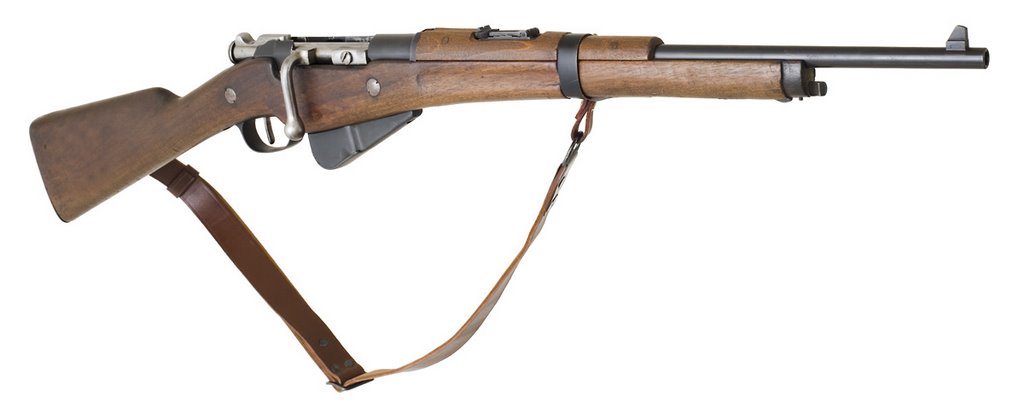
Berthier-Mannlicher Mousqueton d'Artillerie M1916

By the early 1890s, the chickens of France's rush to field the first smokeless powder repeater in the world were coming home to roost. The Lebel, a hastily-designed derivative of the tubular-magazine Kropatschek, and its 8x50mmR cartridge, which was based on the case head dimensions of the earlier 11mm Gras round to theoretically allow for emergency conversions of older rifles, were obsoleted almost overnight by Mauser and Mannlicher designs which were loaded with clips or from chargers. Further, the Lebel's slow-to-load tubular magazine made it ineffecient if cut down to carbine length, allowing for a magazine capacity of only three rounds.

ABOVE: Berthier-Mannlicher Mousqueton d'Artillerie Mle. 1916
Photo by Oleg Volk


In 1890, a carbine designed by Mssr. Berthier, a railroad official in French Algeria, was adopted for use by cavalry and the Gendarmerie. It combined a bolt very similar to the Lebel's with a Mannlicher-type clip-fed magazine. Being saddled with the fat, rimmed 8mm Lebel round prevented the use of a Mauser-style staggered box magazine, and with the cartridges stacked vertically, the new carbine could only accommodate three rounds without (it was thought at the time) making the receiver impractically bulky, but it could be reloaded much faster than any shortened Lebel.


RIGHT: 8mm Lebel rounds are wide and heavily tapered when compared with the more modern 8x57mm Mauser.


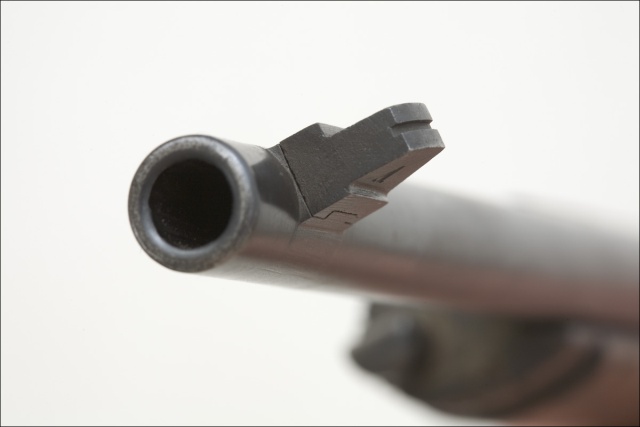
The carbine used a turned-down bolt handle, to keep it from snagging on things while the cavalry troops went about their business with their weapons slung. The sights were the same as those on the Lebel; a tangent-type rear sight combined with a coarse front blade that had a thin notch in the middle for fine aiming. Soon, rifle-length versions of the weapon were fielded for France's Indo-Chinese and Senegalese colonial troops.


LEFT: The unusual French front sight blade.
Photo by Oleg Volk


As the Great War ground on, supply of the Lebel rifles could not keep up with demand, and the rifle-length Berthier was modified with a straight, Lebel-esque bolt handle and issued generally as the Mle. 1907/15. Production was expanded: Previously only made at the St. Etienne arsenal, production was now taken up by the Tulle and Chattelerault arsenals, and contracts were let to Continsouza and Delaunay in France and the Remington Arms Company in the USA. In 1916, Berthier rifles and carbines were modified further thanks to battlefield feedback. A sheet-metal extension was added to the magazine, bringing capacity to five rounds, and one of the defects of the Mannlicher system was ameliorated by the addition of a hinged cover over the clip ejection port on the bottom of the magazine, which had been liable to collect dirt when a soldier went prone.

ABOVE: Manufactured at the Etablissments Continsouza, a private contractor
Photo by Oleg Volk


The final carbine variant, the Mousqueton d'Artillerie Mle. 1916 was one of the most popular variants with the troops: light and handy, with a snag-resistant turned-down bolt handle and side-mounted sling swivels, it could be carried comfortably slung across the back without getting in the way; it held five rounds, and although it couldn't be "topped-off" like the Mauser, it could be reloaded just as quickly. It had a wooden handguard atop the barrel for a handhold during bayonet work, unlike the previous Berthiers, and was well-recieved by poilus outside the artillery troops it had been intended for.

The Mle. 1916 is undergoing the same gradual increase in collector interest as other French longarms. Tatty examples can still be found for not much over a C-note, while a really nice specimen may nudge the $400 mark. Ammunition can be difficult to find, and without the stamped sheet metal clips it is, like any other Mannlicher-type weapon, a single shot. One other thing to beware of is that most surplus Lebel ammunition you will encounter is the later "Balle N" round, a hotter loading designed for machineguns. Unless your rifle is marked as converted to accept this cartridge and has passed headspace checks and safety tests by a competent gunsmith, it's best to view it as a wall hanger and not a shooter, at least where surplus ammo is concerned.