Sunday, December 26, 2021
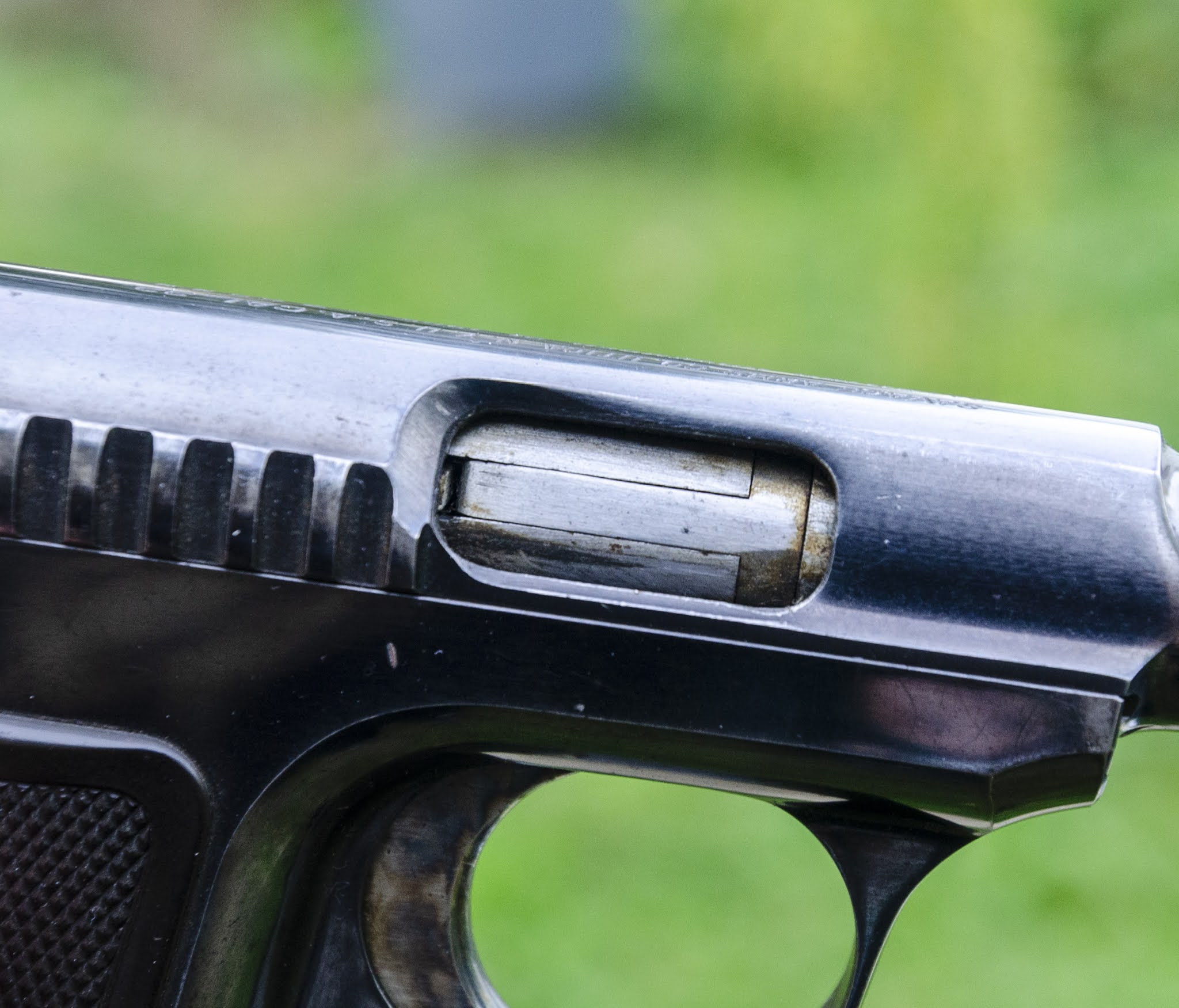
Sunday Smith #71: Bodyguard 380, 2013
Sunday, November 14, 2021
Sunday Smith #70: Model 3913, 199(4)?
Thursday, November 11, 2021
Sunday, Savage Sunday #5...
![]() |
| Advertisement from June, 1914 issue of National Geographic |
Sunday, October 24, 2021
Sunday, Savage Sunday #4...
Sunday, October 17, 2021
Sunday, Savage Sunday #3...
![]() |
| Savage for Victory! |
Sunday, October 10, 2021
Sunday, Savage Sunday #2...
The trigger is still case-colored and it still has the early version of the burr on the cocking piece as well as the very wide slide serrations. The grips on this example are in very good shape, with the "TRADEMARK" lettering still legible on the chief's headdress.
Sunday, October 03, 2021
Sunday, Savage Sunday #1
Monday, March 08, 2021
Classic Reevaluated
There was a time, back when I first got this Model 12-2, that I was skeptical of its utility as a carry piece due to my reluctance to fire +P ammo through early alloy-framed Smiths.
While it will probably hold up to an absolutely normal level of shooting, I'm scarred by having seen a couple early Airweight J-frames crack their frames, probably due to having the barrels torqued in too tightly.
Most vividly was the little flat-latch Model 37, a very early gun in absolutely pristine condition, that an elderly gentleman brought in for a trigger job. He'd finally gotten a carry permit for the revolver that had sat unused on a shelf for decades, and decided it could use a better trigger pull.
Gunsmith Bob did a great job on the trigger pull and took it out on the range to verify that it would reliably light off primers still by putting a couple of cylinders of ammunition through it. The test ammo was standard pressure .38 Special, probably American Eagle FMJ, and the frame cracked there at the barrel shank.
Smith & Wesson replaced the gentleman's Model 37 with a brand new Airweight J-frame, a stainless 637, and the customer was overjoyed. I guess from a practical point of view it was an upgrade, and we all tried not to actually cry in front of him.
At any rate, these days I am less inclined to seek any sort of expansion out of loads from a .38 Special snub. The only way to get it reliably seems to be to use light bullets with the velocity boosted via +P chamber pressures. So you get more blast and recoil and then a bullet that, if it does expand, tends to underpenetrate. If it doesn't expand, it pokes a hole just like a wadcutter.
The fact that most of the switched-on dudes I know who still utilize .38 snubs all carry standard pressure wadcutters in them is what I would call a clue. Plus, Federal's Gold Medal Match has quality control that's second to none and has sealed primers just like premium defensive ammo.
Knowing what I know now, I'd have no hesitation to throw a Tyler T-grip or a set of boot grips on this thing and carry it with a cylinder full of 148gr wadcutters.
We live and we learn.
.
Monday, March 01, 2021
The Great Recession
Tuesday, February 09, 2021
I-Frame Details, Part One
The 2nd Model went through five successive engineering changes from 1903 until production was suspended for the Great War. When it came back in 1919, the new guns were referred to as .32 Hand Ejector, 3rd Models. The lower revolver in the picture above is a 3rd Model with a serial number placing its date of manufacture probably somewhere in the 1920s.
Monday, January 25, 2021
.38 Smith & Wesson
![]() |
| .38 Single Action, 2nd Model |
![]() |
| L to R: .32 S&W Long, .38 S&W, .38 S&W Special, illustrating why the older cartridge fit the small .32 Hand Ejector frame while .38 Spl did not. |
Sunday, January 24, 2021
Sunday Smith #69: .38/.32 Terrier, 1948
![]() |
| The upper sideplate screw, strain screw on the frontstrap, and straight ejector rod all transmit a secret code in Smith nerdspeak. |
Sunday, November 01, 2020
Sunday Smith #68: PC Model 4513 Shorty .45, 1996
When Smith & Wesson got back into the centerfire autoloader game about a decade after WWII, they only offered the pistol in one chambering. They could call it the "9mm" because in 1955 it was the first commercial domestically-produced autoloader purposely designed around the 9x19mm cartridge (Colt's contemporaneous 9mm Commander was just a Government Model with an alloy frame and three quarters of an inch whacked off the barrel.)
When Smith shifted from romantic model names to prosaic model numbers in 1957, the 9mm pistol became the "Model 39". Through the first generation of Smith's modern hammer-fired autos and well into the second, the self-loading pistols were only offered in 9x19mm*.
In fact, it wasn't until 1985, nearly at the end of the era of the three-digit Second Generation autos that Smith released one in something other than 9mm: The Model 645, a double-action challenger to the Colt Government Model. It was a honkin' big pistol with a DA trigger, hammer-dropping safety, five-inch barrel, and a size and bulk that actually slightly overshadowed the classic 1911.
After only a couple years' production, the Third Generation autos supplanted the Second in 1988. The Model 4506 was the full-size replacement for the Model 645, and it was joined in the catalog in 1990 by the Model 4516. The 4516 had a 3.75" barrel and was obviously intended as a compact challenger to Colt's diminutive Officer's ACP, which had hit the streets in 1985.
The problem was that, being constructed entirely of stainless steel, the 4516 was brick heavy at nearly thirty-eight ounces.
Enter the Performance Center, in those days still helmed by Paul Liebenberg and functioning as a limited production hand-built custom shop. In 1996, a small run of "Shorty .45" pistols were sold through distributor Lew Horton, capitalizing on the success of earlier runs of Performance Center Shorty .40 guns.
SKU #170075, labeled as a "4513" on the box, was a 3.5" single stack subcompact .45ACP. It had a hand-fitted titanium barrel bushing, hand-fit frame and slide, hand-tuned action, single-sided hammer-dropping safety, and 7-round magazine. Unlike the similarly-sized 4516, it had an alloy frame with 20lpi checkering on the frontstrap, and this difference between the two pistols knocked a full ten ounces off the gun's weight. The pictured example weighed just over 27oz. on my postal scale.
Lew Horton ordered 662 of the Shorty 45's in 1996 and they had an MSRP of $1145.95. The pictured example was bought in 2020 in used condition in the original Doskocil case with two magazines at my local gun store for $550.
*Well, and .38 Special... Hopefully I'll someday be able to do that Sunday Smith!
Sunday, October 25, 2020
Sunday Smith #67: PC Model 4006 Shorty .40 Mk3S, 1996
Just titling this post was difficult. You'll see this gun referred to by a bunch of different names, with "Shorty Forty" or "Shorty .40" being the most common. Hardly ever is it acknowledged as a Model 4006 variant, which is what Smith calls it on the label on the side of the case.