Sunday, October 24, 2021
Sunday, Savage Sunday #4...
Sunday, October 17, 2021
Sunday, Savage Sunday #3...
![]() |
| Savage for Victory! |
Sunday, October 10, 2021
Sunday, Savage Sunday #2...
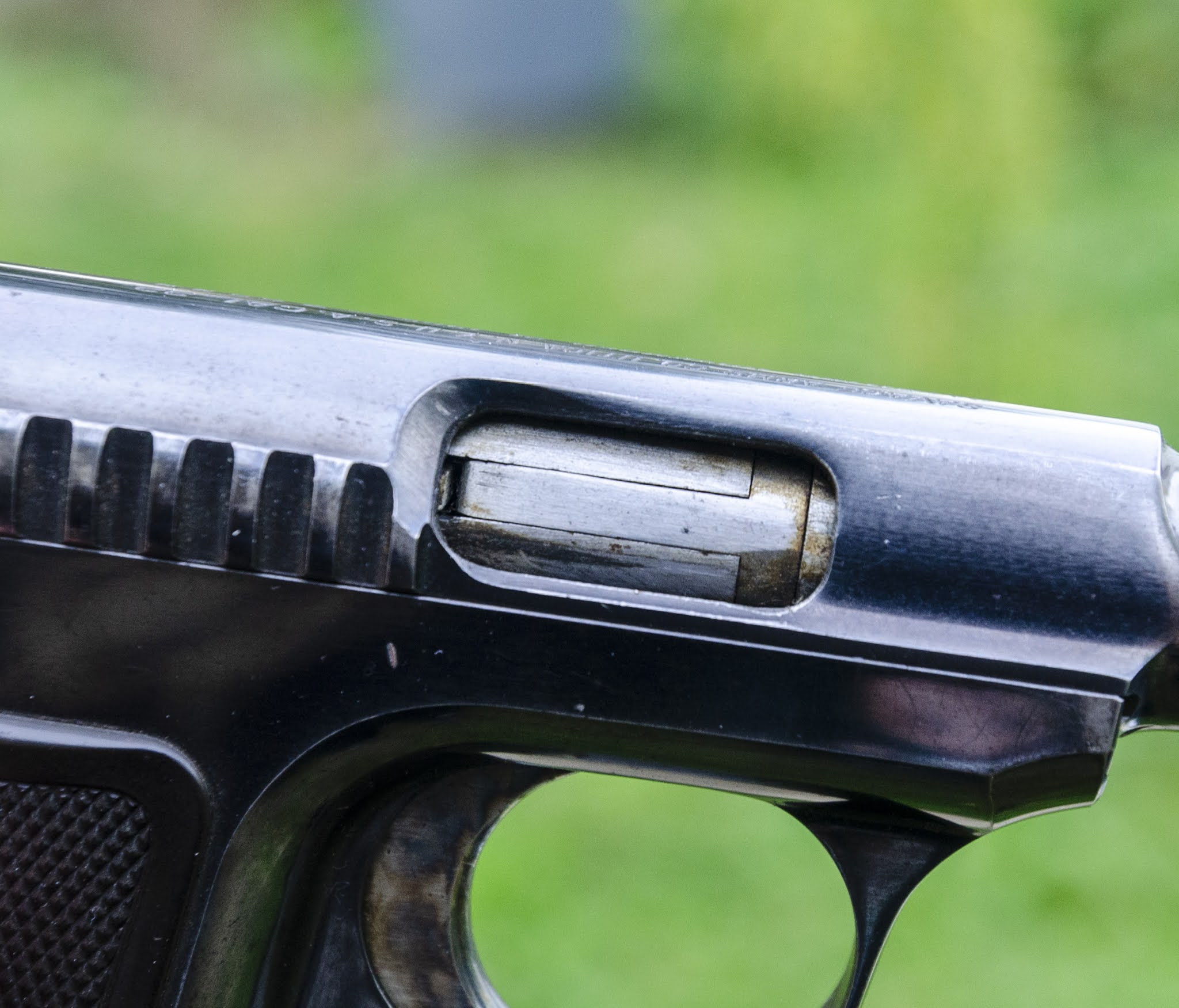
The trigger is still case-colored and it still has the early version of the burr on the cocking piece as well as the very wide slide serrations. The grips on this example are in very good shape, with the "TRADEMARK" lettering still legible on the chief's headdress.
Sunday, October 03, 2021
Sunday, Savage Sunday #1
Monday, March 08, 2021
Classic Reevaluated
There was a time, back when I first got this Model 12-2, that I was skeptical of its utility as a carry piece due to my reluctance to fire +P ammo through early alloy-framed Smiths.
While it will probably hold up to an absolutely normal level of shooting, I'm scarred by having seen a couple early Airweight J-frames crack their frames, probably due to having the barrels torqued in too tightly.
Most vividly was the little flat-latch Model 37, a very early gun in absolutely pristine condition, that an elderly gentleman brought in for a trigger job. He'd finally gotten a carry permit for the revolver that had sat unused on a shelf for decades, and decided it could use a better trigger pull.
Gunsmith Bob did a great job on the trigger pull and took it out on the range to verify that it would reliably light off primers still by putting a couple of cylinders of ammunition through it. The test ammo was standard pressure .38 Special, probably American Eagle FMJ, and the frame cracked there at the barrel shank.
Smith & Wesson replaced the gentleman's Model 37 with a brand new Airweight J-frame, a stainless 637, and the customer was overjoyed. I guess from a practical point of view it was an upgrade, and we all tried not to actually cry in front of him.
At any rate, these days I am less inclined to seek any sort of expansion out of loads from a .38 Special snub. The only way to get it reliably seems to be to use light bullets with the velocity boosted via +P chamber pressures. So you get more blast and recoil and then a bullet that, if it does expand, tends to underpenetrate. If it doesn't expand, it pokes a hole just like a wadcutter.
The fact that most of the switched-on dudes I know who still utilize .38 snubs all carry standard pressure wadcutters in them is what I would call a clue. Plus, Federal's Gold Medal Match has quality control that's second to none and has sealed primers just like premium defensive ammo.
Knowing what I know now, I'd have no hesitation to throw a Tyler T-grip or a set of boot grips on this thing and carry it with a cylinder full of 148gr wadcutters.
We live and we learn.
.
Monday, March 01, 2021
The Great Recession
Tuesday, February 09, 2021
I-Frame Details, Part One
The 2nd Model went through five successive engineering changes from 1903 until production was suspended for the Great War. When it came back in 1919, the new guns were referred to as .32 Hand Ejector, 3rd Models. The lower revolver in the picture above is a 3rd Model with a serial number placing its date of manufacture probably somewhere in the 1920s.
Monday, January 25, 2021
.38 Smith & Wesson
![]() |
| .38 Single Action, 2nd Model |
![]() |
| L to R: .32 S&W Long, .38 S&W, .38 S&W Special, illustrating why the older cartridge fit the small .32 Hand Ejector frame while .38 Spl did not. |
Sunday, January 24, 2021
Sunday Smith #69: .38/.32 Terrier, 1948
![]() |
| The upper sideplate screw, strain screw on the frontstrap, and straight ejector rod all transmit a secret code in Smith nerdspeak. |
Sunday, November 01, 2020
Sunday Smith #68: PC Model 4513 Shorty .45, 1996
When Smith & Wesson got back into the centerfire autoloader game about a decade after WWII, they only offered the pistol in one chambering. They could call it the "9mm" because in 1955 it was the first commercial domestically-produced autoloader purposely designed around the 9x19mm cartridge (Colt's contemporaneous 9mm Commander was just a Government Model with an alloy frame and three quarters of an inch whacked off the barrel.)
When Smith shifted from romantic model names to prosaic model numbers in 1957, the 9mm pistol became the "Model 39". Through the first generation of Smith's modern hammer-fired autos and well into the second, the self-loading pistols were only offered in 9x19mm*.
In fact, it wasn't until 1985, nearly at the end of the era of the three-digit Second Generation autos that Smith released one in something other than 9mm: The Model 645, a double-action challenger to the Colt Government Model. It was a honkin' big pistol with a DA trigger, hammer-dropping safety, five-inch barrel, and a size and bulk that actually slightly overshadowed the classic 1911.
After only a couple years' production, the Third Generation autos supplanted the Second in 1988. The Model 4506 was the full-size replacement for the Model 645, and it was joined in the catalog in 1990 by the Model 4516. The 4516 had a 3.75" barrel and was obviously intended as a compact challenger to Colt's diminutive Officer's ACP, which had hit the streets in 1985.
The problem was that, being constructed entirely of stainless steel, the 4516 was brick heavy at nearly thirty-eight ounces.
Enter the Performance Center, in those days still helmed by Paul Liebenberg and functioning as a limited production hand-built custom shop. In 1996, a small run of "Shorty .45" pistols were sold through distributor Lew Horton, capitalizing on the success of earlier runs of Performance Center Shorty .40 guns.
SKU #170075, labeled as a "4513" on the box, was a 3.5" single stack subcompact .45ACP. It had a hand-fitted titanium barrel bushing, hand-fit frame and slide, hand-tuned action, single-sided hammer-dropping safety, and 7-round magazine. Unlike the similarly-sized 4516, it had an alloy frame with 20lpi checkering on the frontstrap, and this difference between the two pistols knocked a full ten ounces off the gun's weight. The pictured example weighed just over 27oz. on my postal scale.
Lew Horton ordered 662 of the Shorty 45's in 1996 and they had an MSRP of $1145.95. The pictured example was bought in 2020 in used condition in the original Doskocil case with two magazines at my local gun store for $550.
*Well, and .38 Special... Hopefully I'll someday be able to do that Sunday Smith!
Sunday, October 25, 2020
Sunday Smith #67: PC Model 4006 Shorty .40 Mk3S, 1996
Just titling this post was difficult. You'll see this gun referred to by a bunch of different names, with "Shorty Forty" or "Shorty .40" being the most common. Hardly ever is it acknowledged as a Model 4006 variant, which is what Smith calls it on the label on the side of the case.
Sunday, October 18, 2020
Sunday Smith #66: Model 1066, 1991
The history of the 10mm Auto cartridge is well-documented elsewhere (and has been lightly touched on here) but basically it was the culmination of an effort to make an ideal cartridge for a fighting pistol, shooting flatter and further than the .45 and hitting harder than the 9x19mm.
Unfortunately, the pistol with which it had been developed hand-in-glove was a flop, victim of undercapitalization, manufacturing glitches, and poor sales. With the Bren Ten a failure, the cartridge might have sunk below the waves alongside it, had not Colt launched the Delta Elite, a 1911 chambered in 10mm Auto, in 1987.
Two years later, Smith & Wesson launched the Third Generation variant of their large-frame .45ACP single stack auto in the shape of the Model 4506, and with that groundwork laid, 1990 saw Smith's first 10mm Auto offerings, based on the same frame.
The full-size version, dubbed the 1006, was joined in the catalog with a 4.25" barreled variant, the Model 1066.
With its 4.25" barrel length, 39 ounce weight, and $730 MSRP, the Model 1066 was nearly an overlay for a Colt's Combat Commander in stainless, albeit with a double-action trigger, an ambidextrous safety/decocker, and chambered for the new hotness 10mm Auto.
Production of the 1066 ended after only three years, with 5,076 built from 1990-1992.
The above example, in clean shooter-grade condition with long-dead factory night sights and an aftermarket Hogue grip, was purchased (with one magazine and no box) in 2020 for $500.
.
Monday, August 10, 2020
Sunday Smith #65: M&P9, 2010
By the early 1990s, Smith & Wesson's dominance of the law enforcement market was starting to erode. While the Third Generation autos were rugged, reliable, and accurate, so was the polymer upstart from Austria, and there was no way to compete with Glock on price, no matter how many cost-saving measures were applied to the 59xx and 40xx pistols.
In a classic example of "if you can't beat them, join them", Smith & Wesson launched the polymer-framed, striker-fired Sigma line of autos in 1994. Despite applying for a number of patents on the design and slathering it with marketing gobbledygook, there was no hiding the embarrassing fact that the Sigma was, for all intents and purposes, a reverse-engineered Glock 17.
Not only did Glock sue, but the launch timing couldn't have been worse, as the new 17-shot 9mm autoloaders started shipping only months before Congress's new so-called "Assault Weapons Ban" went into effect, neutering the magazine capacity of the gun for private citizens and making "pre-ban" standard capacity Sigma magazines among the scarcest and most valuable from '94 to '04.
Smith settled with Glock out of court and the Sigma morphed into the SW (and later SD) line of pistols, going from an attempt to unseat Glock in duty holsters to a budget-oriented offering for cash strapped pistol customers.
Smith withdrew for a while to lick its wounds before making another serious run at the polymer duty gun market in late 2005 with the M&P series, which borrowed its moniker from the classic fixed-sight service revolvers...er, much to the chagrin of some purists at the time.
The scoffers, including yours truly, were wrong. While it never supplanted the Glock as the dominant pistol choice in the holsters of law enforcement and private citizens in the U.S., it was definitely the leading "not a Glock" from its introduction until fairly recently, when that role was taken over by Sig Sauer's P320. From 2006 until about 2017, you could be sure that any holster or accessory that came out on the market, if it were made for anything other than a Glock, would also be made for an M&P.
The pictured M&P9 features two of those accessories: A LaserGrip and a LightGuard from Crimson Trace. Thanks to its replaceable backstraps, the integration of the LaserGrip on the M&P is among the most seamless of any polymer auto.
The pictured pistol, which was my carry gun from the middle of 2011 until nearly the last day of 2015, is kind of unusual. Product Code 150580 is a factory two-tone: the usual black polymer frame with the stainless slide left in its natural color, rather than Melonited black. It's uncommon enough not to be listed in the SCSW4E. I bought it used at an Indy 1500 gun show back in the summer of '11, still in the factory box with three magazines, for $399 and I'd say that I more than got my money's worth out of it.
.
Sunday, August 02, 2020
Sunday Smith #64: .38 Safety Hammerless Third Model, 1893
As was mentioned the last time we looked at a .38 Safety Hammerless on this blog ('way back in Sunday Smith #2), the commonly repeated origin story of these handguns is probably largely hooey.
Gun shop mythology has D.B. Wesson hearing a tale of tragedy, this time of a young girl getting ahold of daddy's revolver and managing to shoot herself after cocking the hammer. Thus motivated, he sat up that night until the design of the Safety Hammerless sprang fully formed, Athena-like, from his furrowed brow.
In reality, regardless of the actual impetus behind the design, the revolver itself was one of the younger Joe Wesson's first projects at S&W, and passed through two iterations of drawings in 1882 and 1884 before appearing for sale in its final form in 1886.
The pictured revolver is the third iteration of the model. It had gone from a complex "Z-bar" latch holding the frame closed to a simpler push-button one. The hammer was locked in place while the latch was being operated, which added redundancy to the grip safety.
Production of the Third Model started at s/n 42,484 in 1890 and ran through s/n 116,002 in 1898, putting the pictured revolver, with a serial number in the mid 60,000's, somewhere in the early half of that range. In the absence of a factory letter, I'll spitball it at 1893.
It was replaced by the Fourth Model, as seen in Sunday Smith #2, which had a sturdier and more easily operated, yet equally simple to manufacture, "T-bar" toggle frame latch.
With seventy-some thousand built, the Third Model is the second most numerically common variant after the Fourth Model.
The thumb latch had to be pushed down to unlatch. It takes a while to get to where you can do this gracefully without trying to hold the gun shut with your thumb while your other hand is trying to open it. Note that the latch, as well as the spring in the topstrap, is blued on this nickel gun.
That little lip at the top of the square recess is the entirety of the locking surface holding the gun closed. Worn guns may pop right open when fired, which can be exciting.
The front sight on the Third Model, as on the First, Second, and Fourth Models, is pinned to the rib atop the barrel. The front sight on the Fifth Model was an integral part of the barrel.
While the trigger retains only vestiges of case coloring, the bluing on the trigger guard is still fairly nice. Looking to see if these areas are still in their original colors is a good first indicator of a re-nickel job. (See again the .38 Safety Hammerless Fourth Model in Sunday Smith #2). The mother-of-pearl grips are nice, but I do not believe them to be the factory stocks.
.
Monday, July 27, 2020
Sunday Smith #63: Model 4046, mid-1990s
The Smith & Wesson 4046 represents two trends that reached their peak in the mid 1990s. The first is the .40S&W cartridge itself. When "stopping power" became a big buzzword in the wake of the Miami Shootout, the FBI went (briefly) to the 10mm Auto, quickly adopting a downloaded version that achieved ideal results in terminal ballistic testing without tearing up guns and inducing glacial split times.
Meanwhile, South African pistolsmith Paul Liebenberg had gone to work at Smith & Wesson, and convinced them to standardize the wildcat "Centimeter" as the SAAMI-recognized .40S&W. Law enforcement sales were mediocre until congress passed the 1994 ban on new production so-called "high capacity" magazines for civilian sales.
Realizing that the police departments of America were sitting on a gold mine of "pre-ban high capacity magazines", the sales reps of gun companies and LE distributors fanned out across the land, offering a deal to police departments that seemed too good to be true: Swap us those antiquated, underpowered, beat-up used 9mm duty guns, and we'll replace them with these shiny new service pistols chambered in the modern, man-stopping .40S&W! (Please give us all the old magazines, too.)
In the 1990s, Smith & Wesson still enjoyed a commanding position in the duty holsters of America, but it was eroding fast. The initial challenges came from Beretta and Sig, who got some halo glow from military service and a couple big LE contracts. Beretta had scored a win with LAPD in the mid '80s, and the FBI went with SIG Sauer after the S&W 10mm flop. Subsequently, Lethal Weapon and the X-Files sold a lot of 92's and P228's.
Glock, however, had started making inroads around this time. Their price was a powerful selling point, but another they used was the trigger. Unlike the DA/SA triggers common in the duty autos of the time, the Glock had a single trigger pull; the same with every shot.
Back in the revolver days, a large number of departments had converted their wheelguns to DAO*. This was pointed out by the Glock reps pimping G22's in the mid-1990s; "Our Glock 22 is basically a fifteen-shot .40-caliber revolver! Training officers will be easy!"
Beretta and Sig responded with DAOs that were basically their regular DA/SA gun, sans the single-action notch on the hammer. Smith, on the other hand, redesigned the whole thing. The pictured 4046 is not a true DAO, in that it requires the cycling of the slide to partially cock the hammer. The trigger pull then cocks it the rest of the way and fires the piece; there is no restrike capability.
The pull is heavier and longer than a single action pull, but evenly weighted over its travel, smooth, and slightly shorter than a conventional DAO pull. In my personal opinion, it's the best of the factory DAO options except maybe some variants of the HK LEM or a tuned Beretta D-model.
But pulling a DAO trigger consistently while keeping the sights on target is harder than doing the same thing with a shorter, lighter trigger, like the one on a striker-fired gun. Of course, the striker-fired gun is easier to shoot by accident, too. "Well that's just a training issue!" say the striker-fired fans. Yeah? Really? So is being able to hit your target with a DAO trigger.
Due to the current unpopularity of both DAO pistols and .40 caliber ammunition, the above pristine 4046, looking like it hadn't even been issued, was purchased on Gunbroker, along with three 11-round magazines, for under three hundred bucks. It's my current bedside gun.
*Incidentally, revolver conversions to DAO had been for reasons of liability, rather than ease of training, but salespeople don't let fiddly details interfere with the "Features & Benefits" portion of the spiel.
.