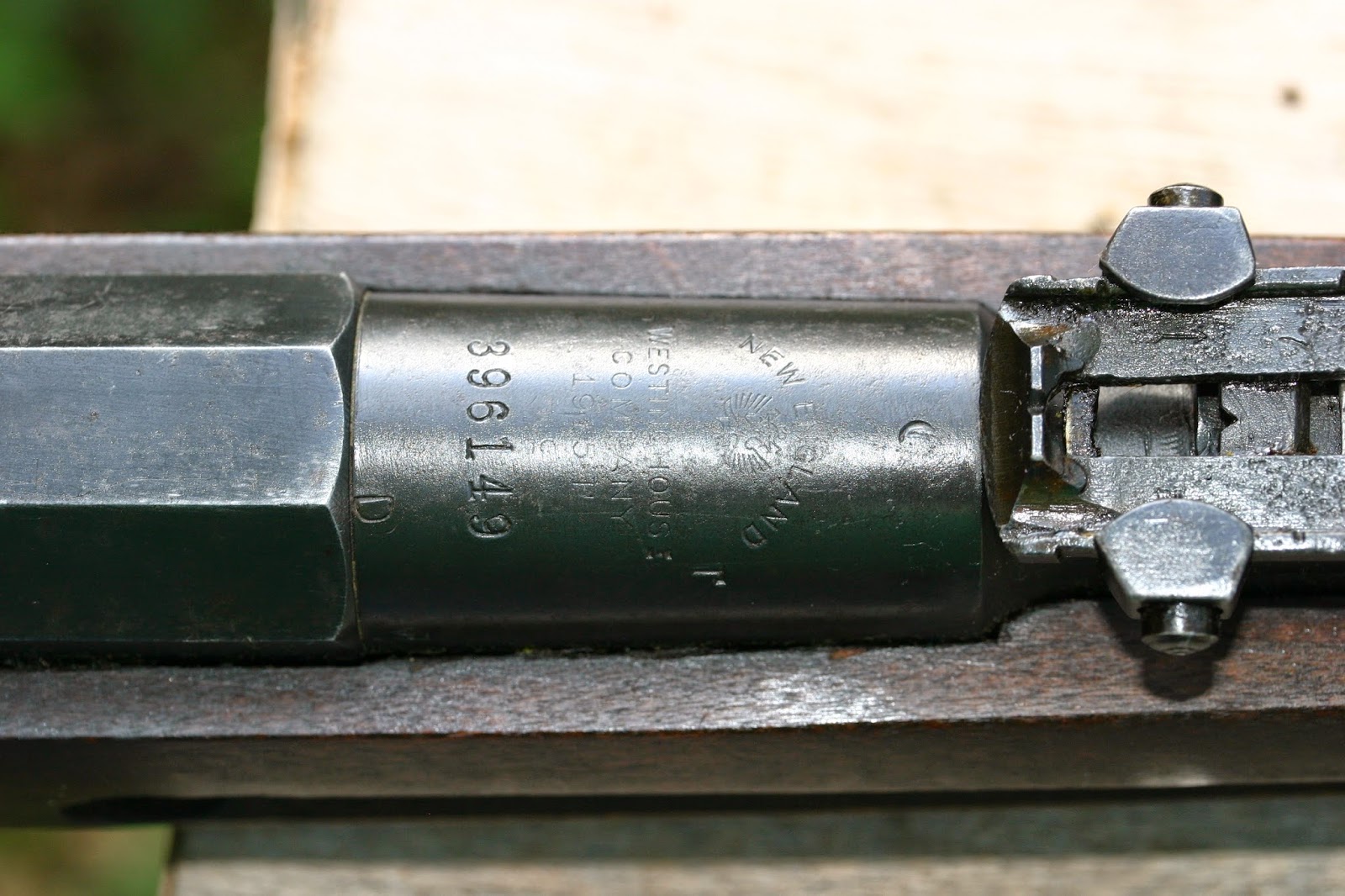
When the Rollin White patent for bored-through cylinders, held by Smith & Wesson, expired in 1870, Colt's was ready with challengers to Smith's various product lines. In 1873 they introduced a direct competitor to Smith's bread and butter wheelgun, the tip-up No.1, in the form of a seven-shot solid-frame .22 rimfire revolver with a single-action spur trigger, the New Line .22.
"New Line" distinguished these solid-frame pistols from their open-top frame forebears. Unlike the tip-up Smith, reloading was accomplished one round at a time through a port in the right side of the recoil shield.
Nickel plated over its brass frame (larger caliber ones appear to have bronze frames), steel barrel & cylinder, and with rosewood grips, it's an adorable little thing. Early ones had conventional cylinder stop notches around the periphery of the cylinder, but later ones, like this 1876-production example, locked up on the rear of the cylinder and had longer cylinder flutes as a result.
Note the pretty nitre-blue on the pin below the loading cutout, and the small amount of niter-blue on the head of the trigger screw on the other side. The bottom of the hammer spur and rear face of the hammer still show this color as well.
Production ran from 1873 to 1877, with 55,343 produced before it was dropped from the catalog in the face of much cheaper competing "suicide specials".
This one was purchased from a local gun store in 2014 for $99. It needs some work, but for a gun built in the centennial year of our nation, it seemed a reasonable price.
.
Sunday, April 03, 2016
Tuesday, March 08, 2016
Use it up, wear it out, make it do, or do without...
The Dreyse 1907 is a .32 ACP blowback pistol that, while obviously influenced by FN's Browning 1900, dodges its patents by using a slide that does not completely enclose the barrel. Instead, the breechblock, which is inside the frame, has a long forward extension running above the barrel. This is the part that has the cocking serrations visible in the photos.
First and Second Variant are pictured above. The guns were produced from 1908 until shortly after the Great War. The top pistol, with a serial number of 66742, is of antebellum vintage, while the second, number 234589, is a much later production gun. Both guns were claimed to be WWII GI bringbacks.
Note the lanyard rings: The 1907 was a popular police pistol and was purchased by the nascent Czech army immediately following the First World War.
The later gun shows an interesting repair where the frame had cracked through at the corner and was repaired by drilling laterally completely through the frame and riveting. I'm not sure I'd trust it to shoot, but I don't have Allied tanks overrunning my neighborhood, either.
Or perhaps it was one of the few pistols a member of the anti-Nazi resistance could get their hands on, and they needed to keep it working? Or perhaps it was just one of the ones exported to the Czech army, which were removed from service for unspecified safety reasons after only a few years.
Either way, the gun was worth the $20 asking price. How could I refuse?
For the most detailed online Dreyse resource, check the Unblinking Eye.
.
Labels:
German pistols,
pocket pistols,
The Thirty Two,
WWI Pistols
Monday, October 26, 2015
Reincarnated Rimfire
Picked up this interesting little piece from a friend at the Indy 1500 gun show this past weekend.
It's a Smith & Wesson .32 Safety Hammerless 1st Model (popularly known as the "Lemon Squeezer" for the grip safety on the backstrap.) This one, however, has been professionally and painstakingly converted from .32 S&W to .22 rimfire.
The most obvious visual clue is the spring-loaded underbarrel ejector rod assembly, à la the Colt Peacemaker.
The pinned half-moon thumbnail of the factory front sight has been replaced with a Marble unit.
The barrel has been bored out and sleeved to .22 caliber.
Here's a detail of the rear of the ejector rod assembly as well as the cylinder face, where you can see the faint traces of the .22 chamber sleeves inset into the bored-out .32 chambers.
The sleeved chambers from the breech end. The cylinder's serial number is much later than the frame's.
I would LOVE to know the history of this gun. The work is immaculate and the re-nickel job is quite nice.The frame dates to 1898, making it an antique, although the cylinder is later, so it's unlikely that the conversion dates to the twenty-year stretch from 1881-1901 where S&W didn't have any .22s in their lineup.
.
Wednesday, January 28, 2015
Harrington & Richardson .25 Self-Loading Pistol
| H&R Self-Loading .25 pistol. The safety worked backwards from the usual, in that up was "fire" and down was "safe". |
"In a firearm, the combination with a frame having a forward extension, a reaction spring mounted in said forward extension, and a barrel, of a breech block or bolt carrier having a semitubular, forward extension to inclose the barrel and to engage said frame and to slide thereon..."In other words, Colt's had the patent to the one-piece slide and breechblock. Remington and Savage dodged this patent with their designs from John Pedersen and Elbert Searle having the breechblock as a piece separate from the slide. H&R went in a different direction by licensing designs from English gunmaker Webley & Scott in which the slide did not "inclose the barrel".
| From top to bottom: Webley .455 Auto, H&R .32, H&R .25, Webley .32 |
![]() |
| No sights, but it has a loaded chamber indicator. |
Although in the catalog from 1912 until 1920, some sources say that production of the .25s actually stopped in 1916, and remaining sales after that date were out of unsold stock. At any rate, only 16,000 were produced, making it one of the rarer early American pocket autos.
Sunday, September 21, 2014
Sunday Smith #53: .32 Hand Ejector Model of 1896
![]() |
| .32 Hand Ejector Model of 1896 |
The top-break latching mechanism on the pocket guns went through several changes to strengthen it before winding up with the familiar "T"-shaped lifting toggle, but no small toggle could be as strong as a solid frame, and in the last decade of the 19th Century, Smith followed Colt onto the market with a solid-framed revolver utilizing a cylinder that swung out to the side for loading and unloading.
The ejector in the new revolver differed from the automatically-operated ones in the top breaks by being a plunger worked by the shooter; hence the new design's designation as the "Hand Ejector" models.
The first one on the market was a pocket-sized gun chambered for a new .32 caliber cartridge known as ".32 S&W Long", which utilized a longer case to prevent the new cartridges from being loaded into older .32 top-breaks. The fluted cylinder had the patent dates and manufacturer's name roll-marked between the flutes rather than atop the barrel; a quirk shared with the contemporary .44 top-break "Favorite" and no other Smith.
![]() |
| It looks weird with no thumb latch. |
![]() |
| A comparison of the arrangement of the sideplate screws of the first .32 Hand Ejector and a 1970s-era Model 31-1 in .32 S&W Long. |
Less than 20,000 were made before it was replaced in 1903 with a new .32 Hand Ejector that was almost fully modern in construction, the odd little lungfish of a gun was never screamingly popular, although it did see service with some police departments, including Philadelphia and Jersey City. Its successors, though, would be some of the most prolific and frequently-copied handguns on the planet.
Saturday, May 17, 2014
Classic Colt's preview...
![]() |
| Colt's New Line .22 Pocket Revolver |
![]() |
| S&W Model 1, 3rd Issue (top) and 2nd Issue (bottom) |
.
Sunday, May 11, 2014
Sunday, January 12, 2014
The other Model 1873 revolver...
Still raw from their defeat at the hands of the Prussians, the army of the French Third Republic underwent a fairly comprehensive, ground-up program of rearmament, and not even the lowly service handgun was left out.
While double-action Lefaucheux pinfire revolvers had seen use with the French navy, the new MAS Mle. 1873 was the first metallic cartridge handgun adopted as standard issue by the French army. Introduced the same year that the U.S. Army adopted the single-action Colt, the Mle. 1873 was a solid-frame double action revolver that used a swing-open gate for loading and unloading, with cartridge ejection chores being handled by a spring-loaded rod in a housing that ran parallel to the half-octagonal barrel.
In another similarity with the Peacemaker, the Mle. 1873 shared its bore diameter with the Mle. 1866 Chassepot service rifle and its imminent replacement, the Mle. 1874 Gras. Unlike the Colt, whose potent .45-caliber round was one of the most powerful handgun cartridges of the black powder era, the MAS fired an 11mm round that dribbled its fairly light 180gr bullets out the muzzle at leisurely velocities less than 700 feet per second.
Colt's first double action revolver in a service caliber, the M1878 "Frontier", is a far more gracile piece than the MAS. However when compared side-by-side, the more martial nature of the French wheelgun is obvious. For instance, it can easily be field-stripped: Using the cylinder pin as a screwdriver, a single screw is removed, allowing the sideplate to be lifted off.
The sideplate retains the left-hand grip panel. Et voila! You have now probably stripped the gun as far as caporal-chef Jacques had any need for taking his gat apart in a foxhole. Taking it down further wouldn't be hard, provided you have someplace to set the fiddly bits. There is even a handy pivoting lever under the grip panel, complete with a knurled tab for a thumbpiece, that can be used to remove the mainspring.
By comparison, the Colt Frontier requires screwdrivers and some needle-nose pliers, and you'd probably best just forget about messing with the lockwork unless your dog tags say "Grant Cunningham".
While the Colt was never standard U.S. issue, a version was contracted with the intention of using them to arm the Philippine Constabulary in the early 20th Century. The MAS Mle. 1873 was the front-line French revolver for roughly twenty years, until replaced by the 8mm M1892, but remained in second-line service through the First World War, and even into the Second.
While double-action Lefaucheux pinfire revolvers had seen use with the French navy, the new MAS Mle. 1873 was the first metallic cartridge handgun adopted as standard issue by the French army. Introduced the same year that the U.S. Army adopted the single-action Colt, the Mle. 1873 was a solid-frame double action revolver that used a swing-open gate for loading and unloading, with cartridge ejection chores being handled by a spring-loaded rod in a housing that ran parallel to the half-octagonal barrel.
![]() |
| MAS Mle. 1873 French ordnance revolver. They were issued in the white. |
Colt's first double action revolver in a service caliber, the M1878 "Frontier", is a far more gracile piece than the MAS. However when compared side-by-side, the more martial nature of the French wheelgun is obvious. For instance, it can easily be field-stripped: Using the cylinder pin as a screwdriver, a single screw is removed, allowing the sideplate to be lifted off.
![]() |
| This one's missing the ejector rod housing as well as the head of the cylinder base pin |
![]() |
| Contemporaries. |
![]() |
| The loading gate on the MAS pivots rearward instead of outward. |
Monday, December 16, 2013
An idea...
Noodling around with the Webley .32, I suddenly got an idea.
One of the oddest features of the little Webley/H&R automatics is their thumb-operated manual safety. It's located fairly far forward on the gun to those used to Browning-pattern pistols and, worse, its operation is backwards: Up is for "fire" and down is for "safe".
However, the lever is a long and thin one and almost seems to be designed to keep the thumb from fouling the slide as it almost certainly would if the positions were reversed. Obviously I need to go do some shooting with this thing.
Sunday, November 10, 2013
Sunday Smith #52: Model 61-2 Escort, 1970
Smith & Wesson was traditionally a manufacturer of revolvers. The company's name and fortune had been built on the Rollins-White patent for the bored-through cylinder, and all through the 19th Century they produced nothing but revolvers, save for the occasional single shot target pistol on a top-break revolver frame or shoulder-stocked revolver carbine.
S&W's first foray into self-loading pistols in the early 1900s was enough of a flop that it wasn't 'til the 1950s that they got back into the market, and then with service-sized autos chambered in 9mm rather than the small vest-pocket type like their earlier venture.
Smith had been working on a new pocket pistol already when legislation that was passed in 1968 caused a market vacuum. The Gun Control Act precluded the importation of handguns that could not obtain a certain amount of "points" on a scale that determined their suitability for sporting purposes. Overnight, an entire class of small, inexpensive imported pocket pistols was wiped from the marketplace and a domestic manufacturer would be foolish to not exploit this opportunity for a windfall.
Like a half-century earlier, Smith & Wesson's offering was based on a Belgian design. This time the template was the Pieper Bayard 1908, best known for being one of the smallest .380 semiautomatic pistols ever sold.
By switching from .380 to .22LR, Smith could utilize a much less expensive cast aluminum frame rather than a machined steel one. The resulting pistol, which hit the market in late 1968, was small, light, reasonably-priced and marketed as the Model 61 "Escort", a name suggestive of its intended role as portable protection for pocket or purse.
Not long into the production run, S&W added a magazine safety, with the resulting model marked "61-1", in the company's tradition of denoting engineering changes with a "dash" number. For 1970, a bushing was utilized to allow more precise barrel fitting, and the result was the 61-2 like the example shown here. The last variant, before production ended, was the 61-3 which used a frame machined from an aluminum forging rather than the cast frame of the earlier variants.
This 61-2 in LNIB condition was acquired for just over $200 in February of 2013. The box bears the price tag from a no-longer-extant downtown Indianapolis gun shop. The tag reads "$46.50".
More good info on the Model 61 Escort can be found here and here.
.
S&W's first foray into self-loading pistols in the early 1900s was enough of a flop that it wasn't 'til the 1950s that they got back into the market, and then with service-sized autos chambered in 9mm rather than the small vest-pocket type like their earlier venture.
Smith had been working on a new pocket pistol already when legislation that was passed in 1968 caused a market vacuum. The Gun Control Act precluded the importation of handguns that could not obtain a certain amount of "points" on a scale that determined their suitability for sporting purposes. Overnight, an entire class of small, inexpensive imported pocket pistols was wiped from the marketplace and a domestic manufacturer would be foolish to not exploit this opportunity for a windfall.
Like a half-century earlier, Smith & Wesson's offering was based on a Belgian design. This time the template was the Pieper Bayard 1908, best known for being one of the smallest .380 semiautomatic pistols ever sold.
By switching from .380 to .22LR, Smith could utilize a much less expensive cast aluminum frame rather than a machined steel one. The resulting pistol, which hit the market in late 1968, was small, light, reasonably-priced and marketed as the Model 61 "Escort", a name suggestive of its intended role as portable protection for pocket or purse.
Not long into the production run, S&W added a magazine safety, with the resulting model marked "61-1", in the company's tradition of denoting engineering changes with a "dash" number. For 1970, a bushing was utilized to allow more precise barrel fitting, and the result was the 61-2 like the example shown here. The last variant, before production ended, was the 61-3 which used a frame machined from an aluminum forging rather than the cast frame of the earlier variants.
This 61-2 in LNIB condition was acquired for just over $200 in February of 2013. The box bears the price tag from a no-longer-extant downtown Indianapolis gun shop. The tag reads "$46.50".
![]() |
| Blue 2-piece box w/reinforced corners. $46.50 price tag from Emro's Sporting Goods. |
![]() |
| Padded leatherette carrying case and cleaning tools. |
![]() |
| The gun itself, with its "woodgrain" plastic grips. Included in the box is an advertisement for Smith & Wesson-brand ammunition. |
![]() |
| Smith & Wesson Model 61-2 Escort with a brace of its Bayard 1908 antecedents, one in .32 and one in .380. |
More good info on the Model 61 Escort can be found here and here.
.
Sunday, October 20, 2013
Imported technology...
![]() |
| Our American Cousin... |
In addition to adding a grip safety, magazine safety, and loaded chamber indicator, the H&R also replaced the "V" recoil spring under the right grip panel with a more conventional coil spring housed in the slide, and replaced the hammer with an internal striker.
Friday, July 26, 2013
Savage "hammer" spurs...
Self-loading pistols of any type were still far from mainstream when Savage put the finishing touches on their Model 1907, and despite the weapon being striker-fired, an external cocking spur was added, which allowed the weapon to be de-cocked like a conventional auto. The spur had the added feature of blocking the sights when the hammer was at rest, which made for a handy visual reminder that the pistol was either uncocked or empty (there being no last-round hold-open feature.)
Savage couldn't resist tinkering with the design, however, and the constant changes probably combined with massive overproduction in the first couple years to eventually doom the pistol on the market.
The second pistol from the left is a Model 1915, introduced as a response to Colt's wildly popular 1903 "Pocket Hammerless". One can only imagine that meeting at Savage headquarters:
Lastly, the pistol on the far right has the spur-type hammer that was always available as an option, but became standard on the final variants of the 1907 and was continued on the Model 1917.
Savage couldn't resist tinkering with the design, however, and the constant changes probably combined with massive overproduction in the first couple years to eventually doom the pistol on the market.
The second pistol from the left is a Model 1915, introduced as a response to Colt's wildly popular 1903 "Pocket Hammerless". One can only imagine that meeting at Savage headquarters:
"These people keep buying Colts!"Thus the 1915, which eliminated the external spur, blanking off the slot in the breechblock, as well as adding a grip safety and a last-round hold-open feature. Unfortunately, the pistol was more expensive to make, sold at lower profit margins for the company, was trickier to disassemble, and the last round hold-open feature was fragile and breakage-prone. Tooling up for Great War arms contracts put paid to the 1915 variant after less than two full years of production, making it the rarest of the little Savage variants.
"They like it because it's hammerless and Colt's advertises that it won't snag on coat pockets."
"But it has a hammer! It's just internal! Our pistol really is hammerless!"
"But people see the spur and think it has a hammer..."
Lastly, the pistol on the far right has the spur-type hammer that was always available as an option, but became standard on the final variants of the 1907 and was continued on the Model 1917.
Saturday, May 18, 2013
Treasure trove...
One of the side benefits of working in a gun store is that it makes collecting cartridges pretty easy; it seems like you're always running across something new and interesting. As my friend Shannon put it, "If you're patient, sooner or later one of everything will walk through that front door." It's how I got everything from 5.7x28mm and 5.45x39mm before they were commonly commercially available to a .470 Nitro Express for my cartridge display board.
My roommate's friend, The Data Viking, dropped by our house the other day with a truly princely gift: His granddad had run a gun store from 1939 on up, and over time had filled four cigar boxes with oddities and rarities Now I'm going to have fun going through them and cataloging the contents!
On the left is a .40-60 Winchester, a cartridge that debuted in 1876. Intended to give Winchester lever guns more hitting power than the pistol calibers of the Model 1873, the Model 1876 was offered in .40-60 up until 1897 and the cartridge stayed in Winchester's catalog until the Great Depression.
Next to it is a .33 Winchester, a cartridge that came out in 1902. Ballistically similar to the .35 Remington, it was replaced in the lineup by the .348 Winchester. Production was discontinued in 1940 and never resumed after the war.
The third cartridge is a .219 Zipper, a high-speed smallbore round for lever action rifles that came out in 1937. Given the difficulty of fitting optics to lever action Winchesters, it never really caught on and was finally put out to pasture in the early '60s.
Bonus: A full box of UMC .32 Smith & Wesson!
My roommate's friend, The Data Viking, dropped by our house the other day with a truly princely gift: His granddad had run a gun store from 1939 on up, and over time had filled four cigar boxes with oddities and rarities Now I'm going to have fun going through them and cataloging the contents!
![]() |
| Central-Fire! |
Next to it is a .33 Winchester, a cartridge that came out in 1902. Ballistically similar to the .35 Remington, it was replaced in the lineup by the .348 Winchester. Production was discontinued in 1940 and never resumed after the war.
The third cartridge is a .219 Zipper, a high-speed smallbore round for lever action rifles that came out in 1937. Given the difficulty of fitting optics to lever action Winchesters, it never really caught on and was finally put out to pasture in the early '60s.
Bonus: A full box of UMC .32 Smith & Wesson!
Labels:
American rifles.,
ammunition,
collecting,
The Thirty Two
Sunday, March 24, 2013
Carbine triviata...
car·bine noun \ˈkär-ˌbēn, -ˌbīn\From the earliest days of general-issue shoulder-fired firearms, it was quickly apparent that regular infantry arms were a little bulky to be lugged around on horseback by the cavalry, while pistols, although eminently portable and useful from horseback, had a hard time hitting targets much smaller than the proverbial broad side of a barn at any kind of distance, and thus was born the carbine.
1: a short-barreled lightweight firearm originally used by cavalry.
...
French carabine, from Middle French carabin carabineer First Known Use: 1592
By the late 19th Century,, the specialized bolt-action carbine was reaching something of a zenith, actually spawning several sub-variants.
Broadly, cavalry carbines tended to have sling hardware on the opposite side of the stock from the bolt handle, allowing the carbine to be slung securely diagonally across the back so it wouldn't be as likely to bounce off at a gallop. Since cavalry were still equipped with sabers and/or lances, cavalry carbines often had no bayonet lugs. Their bolt handles were almost always turned downwards, so as to make them less likely to snag on something while slung behind.
Carbines for engineers, mountain troops, artillery, bicyclists, and others tended to be much more like shortened infantry rifles (and sometimes were.) Sling loops tended to be in the regular place, and these carbines generally had a lug to take the standard bayonet and sometimes had a straight bolt handle like the longer infantry rifles.
The top carbine in the picture below is an Italian Moschetto Mo.91 per Truppe Speciali, made at the Brescia arsenal in 1917: It is a carbine version of the M1891 Carcano intended for special troops like artillery, engineers, and others. It has a tangent rear sight graduated from 600 to 1500 meters that folds forward into a recess cut in the wood handguard to expose a 300m fixed battle sight. If you look toward the toe of the stock, you can see a repair in the wood where the original bottom-mounted sling swivel was moved to the side during an arsenal refit at some time. The bayonet lug on the nose cap is also interesting, since it is oreinted side-to-side rather than fore-and-aft; the hole in the bayonet crossguard would be slipped over the muzzle, and then the bayonet would be rotated onto the lug until it latched. Note also that the 91 T.S. carbine has a cleaning rod threaded into the forend like the larger rifles do.
![]() |
| A pair of Carcano carbines. |
Both carbines here fire the Italian 6.5x52mm Carcano round from 6-shot Mannlicher-style clips, the Carcano action being heavily cribbed from the German Gew.88. The 6.5 fired a heavy-for-caliber round-nosed projectile that had a disturbing tendency to travel in one side of an enemy and out the other without doing much damage in the middle, since its cylindrical dimensions made it extremely stable and not prone to yaw. Interestingly, the Carcano fired this bullet through a barrel with gain-twist rifling, which twisted progressively faster as it went toward the muzzle, at least until WWII production exigencies made them do away with this feature.
![]() |
| These handy little carbines are short and compact, even by modern standards. |
Labels:
19th Century Rifles,
Italian rifles,
WWI rifles,
WWII rifles
Saturday, March 23, 2013
Pistol pairs...
Sunday, March 10, 2013
Condition Is Everything Part III
A Tale of Two Savage 1907s:
I've always had a little bit of a weak spot for these things for a number of reasons: Their Buck Rogers Art Deco raygun looks, the funky lockwork (that thing that looks like a hammer spur is just a cocking indicator connected to the internal striker), and the double-stack .32ACP magazine. Add an interesting ad campaign that targeted novice shooters and women and the fact that in some alternate Harry Turtledove-esque universe a larger version of this gun in .45ACP became the standard US service sidearm, and you've got a pistol with a lot of neat history behind it.
They'd be a fertile field for collecting on a budget, too. There are three main variants (1907, 1915, and 1917) and, when you count the sub-variants and both .32 and .380 caliber versions, you're looking at something like 26 distinct versions, most of which are extremely reasonably-priced compared to their contemporaries with the prancing ponies on them.
I acquired the bottom Savage first, in January of last year at the Indy 1500, and I paid too much for it by half. It's all there, and mechanically functional, but the exterior is a dull gray patina with evidence of old pitting and the bore matches. The right side grip panel is cracked and epoxied, and the grips are worn like the buffalo nickels their logos recall.
This is what is known in Bailey Brower's book
as a "1907-10 Modification No. 2", being the second design change made in 1910, adding the stamped words "SAFE" and "FIRE" on the frame. The most common variant, this example's serial number dates it to 1911, and in the shape it's in, it's worth not too much (if anything) over a hundred bucks. It's what a collector would refer to as a "representative example"; filling a hole in a collection until a better specimen could be acquired.
The top pistol would be that better specimen, purchased about a month later at the show at the Indianapolis National Guard Armory for the same price as the bottom one, except it was a steal this time 'round.
By 1913, the magazine release lever in the frontstrap had been changed so that it was tripped by the pinkie instead of the ring finger, and a loaded chamber indicator had been added. The latter consisted of a flat spring clipped to the barrel visible through the ejection port, which has been beveled at the rear to allow the trigger finger access, allowing one to check loaded status in the dark. The "1907-13 Modification No. 2" added a few internal changes, but was notable externally by the addition of the billboard-sized "SAVAGE" logo on the right side of the frame, above the grip panel.
This pistol is in really quite good shape for a gun that is now 99 years old. The bore and breechface show little evidence of use. The fragile loaded chamber indicator is neither broken nor bent. The grip panels are crisp enough that close examination will reveal the word "TRADE MARK" on the band of the Indian Chief's war bonnet, and the trigger still retains good case coloring. The bluing is worn in spots, but I'd call this an honest 95%+ gun, probably $300 or more, depending on the market.
I've always had a little bit of a weak spot for these things for a number of reasons: Their Buck Rogers Art Deco raygun looks, the funky lockwork (that thing that looks like a hammer spur is just a cocking indicator connected to the internal striker), and the double-stack .32ACP magazine. Add an interesting ad campaign that targeted novice shooters and women and the fact that in some alternate Harry Turtledove-esque universe a larger version of this gun in .45ACP became the standard US service sidearm, and you've got a pistol with a lot of neat history behind it.
They'd be a fertile field for collecting on a budget, too. There are three main variants (1907, 1915, and 1917) and, when you count the sub-variants and both .32 and .380 caliber versions, you're looking at something like 26 distinct versions, most of which are extremely reasonably-priced compared to their contemporaries with the prancing ponies on them.
I acquired the bottom Savage first, in January of last year at the Indy 1500, and I paid too much for it by half. It's all there, and mechanically functional, but the exterior is a dull gray patina with evidence of old pitting and the bore matches. The right side grip panel is cracked and epoxied, and the grips are worn like the buffalo nickels their logos recall.
This is what is known in Bailey Brower's book
The top pistol would be that better specimen, purchased about a month later at the show at the Indianapolis National Guard Armory for the same price as the bottom one, except it was a steal this time 'round.
By 1913, the magazine release lever in the frontstrap had been changed so that it was tripped by the pinkie instead of the ring finger, and a loaded chamber indicator had been added. The latter consisted of a flat spring clipped to the barrel visible through the ejection port, which has been beveled at the rear to allow the trigger finger access, allowing one to check loaded status in the dark. The "1907-13 Modification No. 2" added a few internal changes, but was notable externally by the addition of the billboard-sized "SAVAGE" logo on the right side of the frame, above the grip panel.
This pistol is in really quite good shape for a gun that is now 99 years old. The bore and breechface show little evidence of use. The fragile loaded chamber indicator is neither broken nor bent. The grip panels are crisp enough that close examination will reveal the word "TRADE MARK" on the band of the Indian Chief's war bonnet, and the trigger still retains good case coloring. The bluing is worn in spots, but I'd call this an honest 95%+ gun, probably $300 or more, depending on the market.
Labels:
American pistols,
collecting,
Savage Stories,
The Thirty Two
Saturday, March 09, 2013
Condition Is Everything Part II
"Hey, how much is my gun worth?"Below are two Remington 51 .380ACP pistols, both of which could honestly be described by a non-collector over the phone to the poor gun store clerk as "Well, it's in pretty good shape..."
"Do you have it with you?"
"No..."
"*sigh*"
And they both are. They're both all there; the grip panels are intact and all the markings are clearly legible; their bores are both good and both function and still possess their original magazines...
The top pistol was probably made in 1919 (serial number in the mid 4-digit range) and is about a 95% gun. It has light wear on the high spots around the muzzle and a freckle or two here and there, and nosing around the web and looking at the Blue Book, I wouldn't be too embarrassed to hang a $600 price tag on it at a gun show to see if anyone bit.
The gun below it is also mechanically solid, all there, and functions fine. It's right on the borderline between a Variant I and a Variant II (it has the Remington logo on the frame and the .380 marking on the chamber, but it still has the old 9-serration slide) which dates it to 1921. While it's all there mechanically, the finish is worn to a dull gray patina in most places and there's evidence of previous pitting on the slide... Let's call it 40%, which puts book at $225.
You can see why one of my least favorite phone calls was the ol' "How much is my gun worth?" (There was always an awkward silence as I fought back the urge to say "Hold it up to the phone where I can see it better.")
Labels:
American pistols,
collecting,
pocket pistols,
Remington Relics
Friday, March 08, 2013
They don't hardly make them like that anymore...
Over at the other blog, I posted a picture of my recently-acquired Remington 870 alongside a vintage Remington 10-A I've had for a couple of years.
The 10-A has a forend with a single action bar, and the bottom-ejecting action has a strange little side-hinged flipper that serves as a shell lifter. A Pedersen design, one tends to automatically assume this is an attempt to engineer around Browning patents held by Winchester on the Model 1897. The Model 10 was certainly more modern-looking than the exposed-hammer Winchester, while sharing with it a feature that has sadly vanished from most of our modern slide-action gauges:
![]() |
| Roughly a hundred years separate these two shoguns, although the 870 design, having debuted in 1950, is a classic in its own right. |
Sunday, March 18, 2012
Sunday Smith #51:.35 Semi-Automatic Pistol, 1919

The decades around the turn of the 20th Century were a time of technological change that is hard to appreciate even when reading about it on the screen of a smartphone. In a relative eyeblink, the world went from whale-oil lanterns and horsedrawn carriages to electric light and automobiles. Telephones, automobiles, radio, powered flight: A seemingly endless stream of inventions were changing the landscape of the world, and among those dazzling gadgets were self-loading firearms. Maxim guns were starring in the tales of colonial wars and, with the development of early self-loading pistols, anybody could have this kind of H.G. Wells technology right in their pocket!
Colt's was first off the block, licensing several designs from John Moses Browning, and their sales success had the other major manufacturers scrambling for a slice of the pie. Savage followed quickly, with an ingenious design by Elbert Searle that used a double column magazine and an ad campaign touting "10 Shots Quick!" Harrington & Richardson jumped in in 1912, licensing a design from English firm Webley & Scott.
Smith & Wesson wanted some of this action, too, but had the same problem that the others did: Patents. Colt's Browning patents covered a plethora of details, from the one-piece slide and breechblock to the method of attaching the grip panels to the frame with screws. S&W had two choices: hope to find a handy homegrown savant like Savage did, or shop overseas for a design to license, a la H&R.
Smith settled on a Belgian design, the Clement, and modified it to suit the U.S. market, adding a grip safety and other embellishments that they thought would help sales. Unfortunately, compared to the fairly simple designs from Colt and Savage, the Smith & Wesson was positively baroque, with a parts count nearly double that of its competitors. Further the control placements went beyond counter-intuitive and were actively user-hostile.
The grip safety was a tab on the front of the frame and for some users it took an active effort to disengage. The manual safety was a thumbwheel that protruded through the backstrap and could not be operated with the hand in a firing grip. The heel-mounted magazine release on the earliest ones moved not fore-and-aft like everybody else's, but side-to-side; this was quickly changed. Lastly, the light breechblock necessitated a monster recoil spring in this blowback design, and so a sliding toggle decoupled the breechblock from the spring so that the action could be manually pulled to the rear and them pushed back forward to chamber a round. Good luck not fumbling that under stress.
As though to hammer a nail into their own coffin, Smith & Wesson also designed a new proprietary cartridge for the pistol: .35 S&W Auto. Similar to the .32ACP, the slightly larger round was partially metal-jacketed, with a larger exposed lead driving band that would engage the rifling. The theory was that this would couple the reliable feeding of round-nosed FMJ with the reduced barrel wear of lead bullets. Since everybody else had standardized on the Browning-designed .32, S&W owners had a harder time finding more expensive ammunition for their complex, hard-to-use pistols. This was not a recipe for sales success.
The final straw was the on-again, off-again production of the pistol as Smith intermittently shut down production during the war years of '14-'18 to fill various foreign and domestic military revolver orders. When production resumed at a normal pace after the war, sales continued to be sluggish until the plug was finally pulled in 1922 after a production run of only 8,350. It would be another thirty years and more before Smith & Wesson dipped its toe in the commercial self-loading pistol market again.
Due to its rarity, the Smith & Wesson is among the hardest to find and most expensive of the early American self-loading pocket pistols. Colt's and Savages are out there in the hundreds of thousands, and the H&R and Remington competitors are five and eight times more common respectively. As a result, even a basket case of a Smith parts gun is a rare sight and usually has a price tag of a couple hundred bucks hanging off it, while a pristine example "in the box with the docs" will bring a thousand or more. The above example, from the middle of the production run, is in honest 95+% condition, showing only light handling wear and a pristine bore and unmarred breechface, was picked up for $600 at a gun show in Indianapolis in 2012.
Subscribe to:
Posts (Atom)