Sunday, June 17, 2007

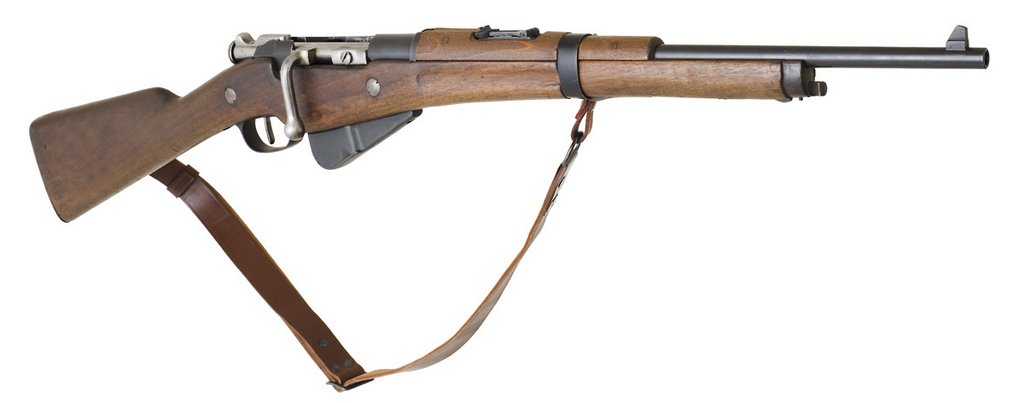
Arisaka Type 38 Cavalry Carbine: A Samurai Mauser.

When Commodore Matthew Perry's ships dropped anchor in Uraga Harbor in 1853, the insular Japanese were brought face to face with a harsh ground truth; if they wanted to remain free from the colonizing spree being engaged in by the great European powers, they needed to modernize. They did so with a vengeance.

By the early 1870s, the Japanese army was armed with German Gew.71 Mausers and French Gras rifles, but they didn't rely on foreign small arms for long; in 1880, they began equipping with the Murata Type 13, a homegrown single shot bolt action sporting a melange of Mauser, Gras, and Dutch Beaumont design features; Winchester was contracted for 100 prototypes, and then production commenced in Japan. Ironically, it would be another twelve years before the land of Commodore Perry would replace its side-hammer Springfield Trapdoors with a bolt-action rifle.

ABOVE: Arisaka Type 38 Cavalry Carbine, photo by Oleg Volk.

When Japan shocked the world by beating a European power in the Russo-Japanese War of 1904, they were equipped with a new rifle designed by a Colonel Nariaki Arisaka in 1897. He trumped this design eight years later with a rugged rifle based on the Spanish M1893 Mauser, known as the Type 38 Arisaka, (Type 38 refers to the 38th year of the Meiji Restoration, with 1868 being Year 1.) This rifle would go on to serve as the primary Japanese service rifle for the next thirty-four years, and remained in production in some factories until the Japanese surrender in 1945.


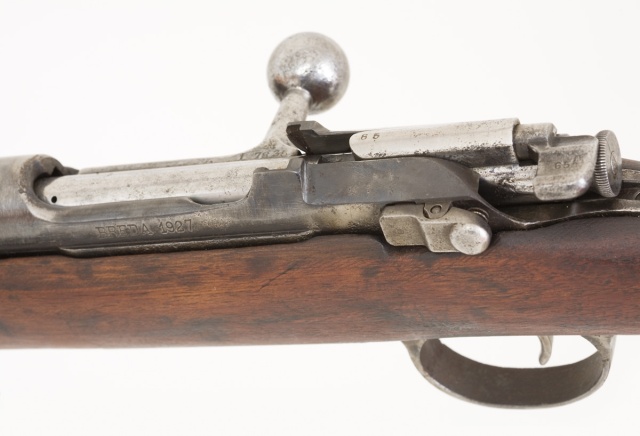
LEFT: The knurled knob on the rear of the bolt served as both a safety and a gas-deflecting flange. Photo by Oleg Volk.


Col. Arisaka's rifle was made in both rifle and carbine formats and had several innovative features, some more useful than others. The rifle handled escaping gas from a ruptured case very well, being equipped with both gas vent holes in the receiver ring and a large round knob on the rear that doubled as both a safety and a flange to direct gas away from the firer's face. Famous gunsmith P.O. Ackley considered the Type 38 to be the strongest military rifle action he'd ever tested. It certainly was a rugged looking rifle.


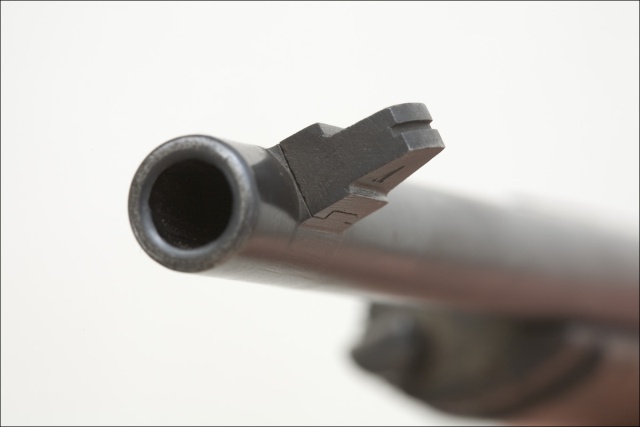
RIGHT: The front sight was drift-adjustable for windage, and was protected by sturdy "wings". Photo by Oleg Volk.


The stock was somewhat blocky in shape, and the butt was of two pieces fitted together tongue-and-groove style, which allowed stocks to be made from smaller blanks. The rifles came from the factory with sliding sheet-steel dust covers, but these were frequently discarded by troops in the field as they rattled as they got loose. The sights consisted of a triangular front blade protected by beefy wings, and a rear ladder-style sight that was graduated to 2,000 meters on the carbine version. The infantry rifle had sling swivels on the bottom attached to the butt and barrel band, while the cavalry carbine had its swivels on the left side of the stock. Both took the same long sword bayonet. Unlike most Mausers and Mauser derivatives, which required a cartridge nose or punch to release the magazine floorplate for unloading, the Type 38 could be unloaded safely by releasing the magazine floorplate by means of a finger-operated catch inside the triggerguard.


LEFT: The Type 38's 6.5x50mm round, in this case a 156gr Norma soft-point, with a 5.56mm NATO round and a .30-'06 M2 ball cartridge for comparison.


Like many other rifle designers in the late 1880s/early 1890s, Arisaka selected a smallbore bullet, in this case a 6.5mm projectile. The military loading launched a 139-grain projectile at 2500 feet per second, giving it slightly better-than-average wallop among the military 6.5's. The flatter crack of the 6.5 was easily distinguished from the deeper muzzleblasts of the .30 caliber rifles used by the Allied forces in the Pacific during WWII, at least according to most memoirs of the time.

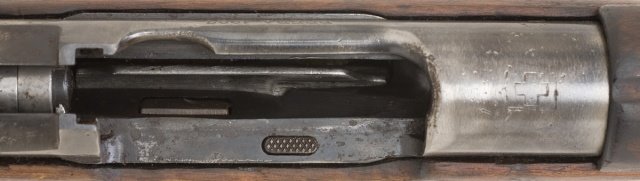
ABOVE: The receiver ring of the Type 38. Note the ground-off mum, indicating a surrendered weapon. (And no more inscrutable or mystical than the canceled "Broad Arrow" on a de-milled British weapon; it just means it's not Imperial property anymore.) The markings below it read "Type", "8", and "3" from bottom to top. Also note the dual gas-escape vents. Photo by Oleg Volk.


Not only did the Type 38 see service with the Imperial Japanese military, but excess rifles were also sold to fellow allies Great Britain and Russia during WWI. Rifles found in the US today will generally either be battlefield-captured souvenirs, or surrendered pieces brought home by returning GIs and sailors or imported after the war by surplus houses. The latter can be distinguished by the fact that the chrysanthemum symbol, an Imperial property mark much like the British "Broad Arrow", on the receiver ring will be defaced or ground off. Prices will start at under $100 for a tatty infantry rifle with a ground mum, and can climb north of $500 for a nice carbine with intact mum and dust cover. Ammunition is still loaded by Norma as well as some specialty houses, but expect to pay dearly for it. This is a rifle for which it is definitely worthwhile to reload, especially since the strong action allows the caliber to shine. As with all WWII weapons, expect a lot of volatility in pricing over the next years as the war passes from living memory, with the passing of the generation who fought it.

Sunday, June 03, 2007

Sunday Smith #4: .32 Regulation Police, 1918


In the early 20th Century, police forces were still a fairly new concept in most of the United States. In much of the rest of the Western world, military or paramilitary forces were used to keep order, but the American distrust of standing armies and the posse comitatus act prevented that in the US. Sheriffs backed up by hired deputies and with the power to raise posses from the general populace had kept order in the USA since the nation's founding, but the idea of permanent municipal police forces gradually spread across the settled regions of the East in the late 19th and early 20th centuries.

Large belt revolvers were seen as uncouth artifacts more appropriate to the unsettled West; an Eastern policeman's gun was as much a badge of authority as it was a weapon. In 1917, Smith & Wesson released a new adaptation of their diminutive I-frame revolver with a four inch barrel and a modified grip frame that allowed the use of wood grips with a squared-off profile to the butt. The new pistol was called the "Regulation Police" and was fairly popular, with many thousands shipping between 1917 and 1942, when the model was discontinued.

The gun in the above photo is a nickeled .32 Regulation Police, holding six rounds of the then-new .32 S&W Long cartridge, probably built in 1918 or thereabouts. While the nickel finish shows some signs of wear and pitting, the grips are worn nearly smooth, perhaps from where an officer rubbed it like a worry stone in the pocket of his frock coat as he made his nightly rounds of Main Street, ensuring that all the doors that were supposed to be locked actually were, and that all was quiet on his watch.

Monday, May 28, 2007

Sunday Smith #3: .32 Hand Ejector 3rd Model, 1924


In the early 1890s Colt's debuted a solid-frame double action revolver with a cylinder that swung out to the side for loading. Smith quickly followed with their own version in 1896. Previous top-break Smiths would automatically eject the spent cases when hinged open, but the solid-frame gun with its swing-out cylinder required the shooter to manually operate the ejector rod in order to dump the empties; consequently, the new revolvers were dubbed "Hand Ejectors". The first Hand Ejectors were small revolvers in the new .32 S&W Long caliber, and their cylinders were unlatched by pulling forward on the ejector rod under the barrel. This frame size came to be known as the ".32" or "I-frame". In 1903, the I-frame was redesigned to add a thumb latch for releasing the cylinder, and a lug was added under the barrel that the ejector rod locked into by means of a detent, giving the Smith & Wesson cylinder a stronger means of locking than their Colt rivals.

The I-frame revolver in the photo above is a .32 Hand Ejector Third Model produced some time in the 1920s. It has a factory nickel finish, a 3.25" barrel, and the factory hard rubber grips are in unusually good condition for their age. It's in fairly good shape, all things considered, with nice bright case coloring still evident on the hammer and trigger, and likely spent most of its many decades in a desk or dresser drawer providing peace of mind to a householder before its honorable retirement as a collector's piece only occasionally exercised at the range.

Sunday, May 20, 2007

Sunday Smith #2: .38 Safety Hammerless 4th Model, 1899


In 1887, S&W introduced its "Safety Hammerless" or "New Departure" models. Legend (surely apocryphal) has it that Mr. Wesson was disturbed by the tale of a child accidentally shooting himself with a small-frame S&W wheelgun, leading to the invention of a small-frame pocket revolver that couldn't be cocked, had a horrendously heavy double action trigger pull, and required that a grip safety on the backstrap be depressed in order for the trigger to be pulled in the first place.

In a move that seems alien to our lawsuit-besotted times, the Safety Hammerless revolvers shipped from the factory with a pin under the stocks that could be used to disable the grip safety. Interestingly, these pistols (known as "Lemonsqueezers" to their aficionados,) with their enclosed hammers and double-action-only triggers, became the pattern for the hammerless "Centennial" S&W revolvers that are the preferred pocket pistols of today's cognoscenti.

The pistol in the above photo is a .38 Safety Hammerless 4th Model, circa 1899. It has been re-nickeled, which can be deduced from a distance by the fact that the trigger is no longer case-colored and the trigger guard is bright rather than black. Despite its age, it still fires .38 S&W cartridges reliably and, if one can hold the hair-fine sights on target through the 15+ pound trigger squeeze, will hit what one is aiming at.

Saturday, May 19, 2007

Japanese Type I rifle: An unusual hybrid.

In the late 1930s, Imperial Japan's ongoing invasion of China was beginning to place a strain on the ability of her arsenals to keep the army supplied with rifles. With the army taking all the rifle production from home, the navy was forced to go shopping for a source of rifles for their naval infantry. A call to their new Axis partner, Italy, resulted in one of the more unusual military rifles of WWII.


ABOVE: Japanese Type I rifle. Photo by Oleg Volk.

The new rifle, referred to as the "Type I", was a hybrid of Italian and Japanese features. (Sort of like ramen al dente, or a teriyaki beef calzone. Mmmm. Anyway...) The rifle's action was that of the Mo. 1891 Carcano, which itself was a more-or-less direct ripoff of the old Gew.88 "Commission Rifle", sans the usual Mannlicher-style magazine. In its place was a Mauser-type box magazine that could be fed rounds from stripper clips. The rifle was chambered for the standard Japanese 6.5x50mm cartridge, and the furniture and sights were pure Arisaka, down to the two-piece dovetailed buttstock. Unlike other Japanese service rifles, they were not marked with the Imperial chrysanthemum on the receiver ring. In fact, except for the serial number and various small proof marks, they were remarkably devoid of markings of any sort.

Never common on the US collector scene (less than 60,000 were produced; compared to millions for most other WWII service rifles) it's possible to go many years without ever seeing one at a store or gun show. It's not listed in the Blue Book or the Standard Catalog of Military Firearms. It's mentioned but not pictured in Japanese Rifles of World War II and Scarlata's Bolt Action Military Rifles book. At the previous gun store I worked at, an old guy walked in the door with a long rifle in tow:

"Hey, I got this ol' military rifle. A buddy of mine tol' me that this lady that works here knows a lot about ol' army guns, collects 'em, even, and could tell me what it's worth."

"That'd be me."

As he started to heave the rifle up onto the counter, saying "I think it's Japanese...", I heroically kept from squeaking "Ohmigod! It's a Type "I"!" I'd never seen one in the steel before.

"So, what's it worth?"

"Well, sir, it's hard to say. The gun isn't in any of the usual price guides. Obscurity may work against it, the bore is a nasty dark orange with corrosion, and ammo is so expensive that an empty magazine means the gun's nearly totalled. On the other hand, it's cosmetically nice, and someone who knows what it is and is just dying to have one for their collection may be willing to pay well to get it. What do you figure you need to get out of it?"

"Well, I'd like to get out of it what I've got in it..."

"Which is? If you don't mind me asking..."

"Naw. I paid $75 for it, and I reckon I've got $5 worth of my time in running it over here. How's $80 sound?"

"Let me call my boss."

I walked in the back room and rang him on the cell phone. Bear in mind my boss at that shop didn't know one milsurp from another. To him, they're all just junky old rifles.

"Hey, I've got this guy that wants to sell us a Type I." *long pause* "It's a rifle with Arisaka-style parts on a Carcano action." *longer pause* "Anyhow, it's an oddball old Japanese rifle. He wants $80 for it."

"I dunno, money's still kinda tight right now. You think we could sell it for $150?"

"Hell ye... er, I mean, I know somebody who'd pay $150 for it."

"Who?"

"Me!"

"Okay, give him $80."

Back out front.

"Here you go, sir."

"Thank you very much, ma'am; if I find anything else, I'll let you know."

Later, my boss apparently decided that he could live with making only a $50 profit off me, instead of a $70 one, which was just fine with me. The rifle in question turned out to be one that was produced at Beretta, rather than one of the more common government arsenal-produced specimens. Ammunition is still produced by Norma, but at today's prices, two and a half boxes actually equal what I paid for the rifle, so until I get dies in the caliber, it won't get shot much. Whether it gets shot or not, it's an interesting artifact from WWII and makes for quite the conversation piece.

Sunday, May 13, 2007

Sunday Smith #1: .32 Double Action 3rd Model, 1883


Smith & Wesson is, if not the oldest surviving American gunmaker, the only American arms company who has continued to fill the same market niche since their inception. In an era when Colt dominated the military contract market, S&W purchased a patent from Rollin White and began turning out a line of tiny revolvers chambered for the then-new .22 rimfire cartridge. Despite occasional military interest, Smith & Wesson has been turning out revolvers and pistols mostly for the civilian and law-enforcement market since 1857, the date of introduction of the Model One. (Before this, they made lever-operated pistols based on the Volcanic pattern.)

Smith & Wesson collecting is still a wide-open and fertile field. With tens of millions of revolvers and pistols made to hundreds of patterns over the last 150+ years, it's easy to start a modest collection. Rarer models may have started commanding high prices, but even a pristine Triple Lock or Registered Magnum is a bargain when compared to a cherry first generation Colt Peacemaker. Hence, the Sunday Smith series; a more-or-less chronological walk through my S&W collection, with a dab of history and pricing data to boot.

The first gun featured, and the oldest Smith currently in my collection, is a .32 Double Action 3rd Model, dating from approximately 1882 or '83. The gun is chambered in .32 S&W, one of the oldest centerfire cartridges still extant, and sports a 3.5" barrel and a nickel finish. These were intended as pocket pistols in an age when most gentleman thought nothing of having a handgun in their coat pocket, and many ladies felt likewise. The tiny size of the gun is shown by the 1937 penny included for scale. These small-frame top-breaks are still cheap to acquire in average condition. As one can guess from the shells showing in the cylinder, this one is still a safe shooter, and I paid under $200 for it from a private seller at a gun show in April of 2006.

Saturday, May 12, 2007

Springfield M1903 Mark I: American Icon.

The United States Army was slow to field a breechloading repeater, the single-shot "Trapdoor" Springfield M1873 proving adequate for the needs of a military that was mostly involved in Indian fighting. By the early 1890s, however, the need for a new rifle was apparent and after an open trial the Krag Jorgensen rifle was settled on, being adopted as the M1892. Within six years it would see its first test in combat.

The Spanish-American War of 1898 marked the first time that armies equipped with the new smokeless powder magazine-fed rifles faced each other. The Spanish army was equipped with the M1893 Mauser, a thoroughly modern design, which featured Mauser's stripper clip loading system which allowed a soldier to strip five rounds into the magazine at once from a disposable sheet-metal clip. This contrasted sharply with the Krag, which required the soldier to dump loose rounds into the magazine; an easy thing to fumble on a two-way rifle range. The Mauser was also stronger, and fired a higher velocity round, which gave it a flatter trajectory. The Krag's action was incapable of taking the pressures involved in firing the newer, faster rounds. Despite winning the war, the US Army immediately began seeking a replacement for the Krag Jorgensen.

ABOVE: M1903 Mark I, photo by Oleg Volk.

After studying captured Spanish rifles, the United States adopted the United States Magazine Rifle, Caliber .30, Model of 1903. It was destined to be an icon; of all the myriad weapons produced at the government arsenal over its many decades of operation, when one says "Springfield", it is understood that one means the M1903. The '03 was a radical departure from the contemporary military practice of issuing a long rifle to infantry and a short carbine to cavalry; it split the difference with an overall length of roughly 43 inches, and the same rifle was issued to all branches. This was the same course Britain took with the SMLE in 1904; Germany didn't follow suit until the introduction of the kar 98k in 1935. The early rifles had a flimsy, fiddly rod bayonet and a simple, sturdy tangent sight like that found on the Mauser. These were quickly replaced with a sturdy sword bayonet, and a fiddly, complex rear sight more at home on the manicured ranges of Camp Perry than on a chaotic battlefield.


LEFT: Complex Springfield rear sight was windage adjustable, and marked out to 2,850 yards. The lower peep in the example is set at 800. Photo by Oleg Volk.


Service in the trenches of World War One showed a need for a higher volume of fire than could be delivered by the bolt-action rifle when clearing trenches or suppressing enemy fire during the dash across no-man's land. A hasty secret program resulted in a device that would replace the bolt of the Springfield, allowing the rifle to fire semiauto pistol cartridges from a 32-round magazine. Known as the "Pedersen Device", rifles meant to use it are marked "Model 1903 Mark I" and are easily distinguished by the oval port cut in the left side of the receiver to allow the ejection of spent shells.


RIGHT: The ejection port for the Pedersen Device. Photo by Oleg Volk.


The M1903 was one of the most beloved service arms in US history. It was the primary rifle of our troops for thirty three years, and served on long after that as a sniper rifle or in rear-echelon roles. When it was replaced by the M1 Garand in the 1930s, resistance to the change was fierce, and the new rifle met with a level of scorn that not even the M16 faced. Over a million Springfields have gone on to become hunting rifles, family heirlooms, and collector's pieces in the US, and original examples in good condition are demanding ever more stratospheric prices on the collector's market. A Mark I with the correct stock and barrel (which the rifle in the photos does not have, more's the pity) can bring in excess of $2,000, while even a homely WWII-era '03A3 is rapidly becoming a $500 proposition. A joy to shoot and a joy to look at, no collection of American militaria is complete without one.


Timeless lines. Photo by Oleg Volk.

Monday, December 11, 2006

Vintage gun pinup No.1


1948-vintage Polish-made Pistolet TT, aka "Tokarev".


Imported by Tennessee Guns in Knoxville, this Tokarev is one of the relative few that bear the "FB Radom" logo rather than the "Circle 11" Warsaw Pact country code for Poland. (Only those made in '48 and '49 had the former.) The Tokarev, designated Wz48 by the Poles, remained the standard Polish military sidearm into the '60s, when it was replaced by the P-64, which was a PPK-esque pistol chambered for the 9mm Makarov cartridge.

Other than the serial number and year of manufacture atop the slide, the small proofs in the triggerguard area, and the serial number on the left rear of the frame, these guns are devoid of markings. They also show a level of fit and finish unusual in a mid-Cold-War Warsaw Pact firearm.


LEFT: Polish Wz48 Tokarev. Photo by Oleg Volk.


As an interesting aside on the perils of believing everything you read, in a sidebar in the second edition of the Standard Catalog of Military Firearms, gunwriter Charlie Cutshaw praises the Polish Tokarev as the most comfortable variant to shoot, stating that the Poles had equipped theirs with thumbrest grips and a manual safety. This is untrue, as the crude manual safety (which only blocks the trigger) and the thumbrest grip were retrofitted by the importer in order to gain enough "points" to be importable under the handgun provisions of the Gun Control Act of 1968; the pistols originally had flat grips and no manual safety. The embarrassing sidebar disappeared in the third edition of the Standard Catalog, but the description still lists the Polish Tok as a "Polish copy with manual safety", and Cutshaw's sidebar is repeated almost verbatim elsewhere on the 'net. Don't believe everything you read.

Friday, December 01, 2006

Ask The Gun Nut: Why don't they...?

Dear Auntie Gun Nut,

I think that the British Bren gun of WWII fame is so cool! Why can't I find a cheap modern semiauto copy?


Gentle Reader,

The Bren gun had a receiver machined from a single forging. The stripped receiver weighed four and a half pounds. The forging from which it was finish-machined weighed twenty-two pounds. That's a big pile of metal chips, even for a CNC machine...

Saturday, November 25, 2006

Future Additions to the Museum...

Although the museum expands in a largely random fashion, I always have a wish list in the back of my mind. In addition to the wish list, I have a more practical one of firearms I'm actually likely to find and be able to afford...


1) The German collection: Kar. 71, Gew. 71/84, Gew. 88/05, Gew. 98 (Transitional), Kar. 98k.
What I'd like to add: A G43 autoloader, or a Dreyse.
What I'll likely get: An intact Gew. 98, complete with the rollercoaster (Lange Vizier) sight.

2) The French collection: Gras Mle. 1874 M80, Berthier-Mannlicher Mle. 1907/15 M16, and Mousqueton d'Artillerie M1916, MAS Mle. 1936, MAS Mle. 1949-56.
What I'd like to add: A Chassepot.
What I'll likely get: An Mle. 1886 Lebel. If I can ever find one.

3) The British collection: Enfield Pattern 1853 rifle (replica), Martini-Henry Mark I, Enfield SMLE Mk.III*, Enfield No.4 Mk.2.
What I'd like to add: A real Tower musket (aka "Brown Bess"), or a Lee-Enfield Mk. V.
What I'll likely get: A replica Brown Bess, or a No.4 Mk.1.

4) The Japanese Collection: Type 38 cavalry carbine, Type 99 short rifle, Type "I" rifle (Beretta marked!).
What I'd like to add: Type 2 paratroop rifle or Arisaka Type 30.
What I'll likely get: Type 38 rifle.

5) The Russian collection(ette): Mosin Nagant M91/30 ('44 Izhevsk), Tokarev SVT-40.
What I'd like to add: An Imperial-era Mosin M1891, un-altered.
What I'll likely get: An M38 carbine.

6) The American collection: M1 Garand, Springfield M1903 Mk.I, Eddystone M1917, M1896 Krag Jorgensen, Remington Model 11 riot gun.
What I'd like to add: Lee straight-pull U.S. Navy musket.
What I'll likely get: M1 carbine or M1873 floptop Springfield.

7) The Swiss collection: Vetterli Gew. 71, Schmidt Gew. 96/11.
What I'd like to add: Kar. 1911
What I'll likely get: The ubiquitous K31.

8) Mauser Miscellania: Spanish FR-8, Chinese Chiang Kai Shek, Siamese M1903, Swedish M1896/38, Argentine Mo. 1891, Venezuelan M24/30 carbine, Chilean M1895 carbine.
What I'd like to add: Argentine M1909 or an OVS M1895.
What I'll likely get: A Swedish M1896 or Yugo M48.

9) Mosin Miscellania: Finnish M39, Hungarian 44.M.
What I'd like to add: Polish M1891.
What I'll likely get: Finnish M28 or M28/30.

10) Miscellaneous Miscellania: Carcano Mo. 1938 carbine, Steyr-Mannlicher M95/30, Mannlicher-Schoenauer M1903/14, FN SAFN-49.
What I'd like to add: A Remington rolling block of some type, or my ultimate holy grail: A Remington Pontificio.
What I'll likely get: A vz. 52 rifle. I feel this is almost a certainty. (ie. I have one on layaway. :) )


Hints, bird-dogging, suggestions and pointers always welcome. Donations will not be turned away, either. ;)

Tuesday, November 21, 2006

Gewehr 88: A rifle designed by committee.

Between 1871 and 1898, the Germans issued four different bolt action rifles. It started with Mauser's seminal Gew. 71, an 11mm black-powder cartridge breechloader. This rifle was standard issue to the armies of the newly unified Germany for thirteen years, when it was replaced by the Gew. 71/84; essentially the same weapon, but with the addition of a tubular magazine below the barrel. After the shock of the French Lebel, the Germans put the Gewehr Prufungs Kommission (Rifle Testing Commission) at the Spandau Arsenal to work designing a new rifle. Initially, it was suggested to just rework the existing 71/84 to a smaller-caliber smokeless round, but this was overridden by a desire to get a quantum leap ahead of the French and their tubular magazine Lebel.

Mauser wasn't consulted, due to the fact that the contracts he had with the Ottoman Empire contained stipulations that any new rifles he made for Germany would also be used to fill the balance of open orders he had with the Turks. Bereft of the country's premier rifle designer, the committe went to work, and produced a result in a surprisingly short time.

ABOVE: Gewehr 88/05, photo by Oleg Volk.

The committee-designed weapon was a hodgepodge of Mannlicher, Mauser, and other odds & sods. It had a Mauser-esque safety and trigger allied to a new bolt, a magazine system so like that designed by Ferdinand Mannlicher that the Germans lost a patent infringment lawsuit to Steyr, and was most notable for its bizzare tubular sheet steel barrel sleeve that was intended to keep accuracy from being affected by stock warps or swells, while still giving a soldier something to grasp during bayonet work that wouldn't burn his hand. The new arm went into service in 1888 as the Gew. 88, but is better known to us as the "Commission Rifle."


LEFT: The distinctive sheet steel barrel shroud of the Gew.88. Photo by Oleg Volk.


RIGHT: The wing safety was a more-or-less direct copy of Paul Mauser's designs. Photo by Oleg Volk.


Paul Mauser took der Vaterland's acceptance of a non-Mauser rifle as a personal snub and set to work designing a series of rifles that eclipsed it entirely. The culmination of the resulting evolutionary tree was the Gew. 98, which replaced the Commission Rifle after the latter had only been in use for ten years, and is regarded by some (including your humble scribe) to be the pinnacle of the era of the military bolt-action rifle.

Ironically, the Gew. 88's major combat debut with the German armed forces took place after it had already been replaced as the standard rifle by Mauser's Gew.98. German naval infantry in China during the Boxer Rebellion were largely equipped with the Commission Rifle. In an interesting twist, its commercial success made it one of the most common rifles used by their Chinese opponents as well. With the coming of the Gew.98 and its faster spitzer bullet, many old Gew.88s were refurbished to use the new rounds and the stripper clip loading system that came with them. The converted weapons, known as Gewehr 1888/05s, could be identified by the stripper clip guides affixed to the rear of the receiver, the sheet metal block closing off the old clip ejection port on the bottom of the magazine, a notch machined in the receiver ring to clear the longer pointed noses of the new rounds as they were loaded, and an "S" marked above the rifle's chamber. Thus modified, they soldiered on well into WWI, long after their obsolescence.


RIGHT: Detail of the Gew.88/05's magazine floorplate, showing the sheet metal cover closing off the old clip ejection port. This was a major improvement, as the old Mannlicher system could introduce dirt into the magazine when the firer went prone. Photo by Oleg Volk.


LEFT: This rifle, originally made at the Danzig government arsenal in 1890, shows the signs of being upgraded to the 1888/05 standard. Visible are the notch for clearance of spitzer bullets and the "S" mark showing that the rifle had been altered to use the newer round. Photo by Oleg Volk.


Commission Rifles were the red-headed stepchild of German rifle collecting for many years, selling for not much over $100 as recently as four or five years ago, and they're still cheap compared to their more famous Mauser brethren. As has everything else in the world, however, they've become more expensive than yesterday, and a really nice Gew. 88 can set you back more than three hundred dollars now. (As a friend commented: "They're actually wanting money for Commission Rifles these days!") Still, no collection of German military rifles is really complete without at least one example of the only non-Mauser rifle that country issued for almost seventy-five years.


(PS: I am going to avoid getting into the arcana of "J-bore" versus "S-bore" rifles, handloads, pressure levels, lengthened throats, rebarrellings, and whatnot, and say that before you decide to shoot your Commission Rifle, you should have it checked over (complete with chamber casting) by a competent gunsmith. Don't believe what the Jerries may have stamped on it under wartime duress; the eyesight you save may be your own.)

Sunday, November 12, 2006

Berthier-Mannlicher Mousqueton d'Artillerie M1916

By the early 1890s, the chickens of France's rush to field the first smokeless powder repeater in the world were coming home to roost. The Lebel, a hastily-designed derivative of the tubular-magazine Kropatschek, and its 8x50mmR cartridge, which was based on the case head dimensions of the earlier 11mm Gras round to theoretically allow for emergency conversions of older rifles, were obsoleted almost overnight by Mauser and Mannlicher designs which were loaded with clips or from chargers. Further, the Lebel's slow-to-load tubular magazine made it ineffecient if cut down to carbine length, allowing for a magazine capacity of only three rounds.

ABOVE: Berthier-Mannlicher Mousqueton d'Artillerie Mle. 1916
Photo by Oleg Volk


In 1890, a carbine designed by Mssr. Berthier, a railroad official in French Algeria, was adopted for use by cavalry and the Gendarmerie. It combined a bolt very similar to the Lebel's with a Mannlicher-type clip-fed magazine. Being saddled with the fat, rimmed 8mm Lebel round prevented the use of a Mauser-style staggered box magazine, and with the cartridges stacked vertically, the new carbine could only accommodate three rounds without (it was thought at the time) making the receiver impractically bulky, but it could be reloaded much faster than any shortened Lebel.


RIGHT: 8mm Lebel rounds are wide and heavily tapered when compared with the more modern 8x57mm Mauser.


The carbine used a turned-down bolt handle, to keep it from snagging on things while the cavalry troops went about their business with their weapons slung. The sights were the same as those on the Lebel; a tangent-type rear sight combined with a coarse front blade that had a thin notch in the middle for fine aiming. Soon, rifle-length versions of the weapon were fielded for France's Indo-Chinese and Senegalese colonial troops.


LEFT: The unusual French front sight blade.
Photo by Oleg Volk


As the Great War ground on, supply of the Lebel rifles could not keep up with demand, and the rifle-length Berthier was modified with a straight, Lebel-esque bolt handle and issued generally as the Mle. 1907/15. Production was expanded: Previously only made at the St. Etienne arsenal, production was now taken up by the Tulle and Chattelerault arsenals, and contracts were let to Continsouza and Delaunay in France and the Remington Arms Company in the USA. In 1916, Berthier rifles and carbines were modified further thanks to battlefield feedback. A sheet-metal extension was added to the magazine, bringing capacity to five rounds, and one of the defects of the Mannlicher system was ameliorated by the addition of a hinged cover over the clip ejection port on the bottom of the magazine, which had been liable to collect dirt when a soldier went prone.

ABOVE: Manufactured at the Etablissments Continsouza, a private contractor
Photo by Oleg Volk


The final carbine variant, the Mousqueton d'Artillerie Mle. 1916 was one of the most popular variants with the troops: light and handy, with a snag-resistant turned-down bolt handle and side-mounted sling swivels, it could be carried comfortably slung across the back without getting in the way; it held five rounds, and although it couldn't be "topped-off" like the Mauser, it could be reloaded just as quickly. It had a wooden handguard atop the barrel for a handhold during bayonet work, unlike the previous Berthiers, and was well-recieved by poilus outside the artillery troops it had been intended for.

The Mle. 1916 is undergoing the same gradual increase in collector interest as other French longarms. Tatty examples can still be found for not much over a C-note, while a really nice specimen may nudge the $400 mark. Ammunition can be difficult to find, and without the stamped sheet metal clips it is, like any other Mannlicher-type weapon, a single shot. One other thing to beware of is that most surplus Lebel ammunition you will encounter is the later "Balle N" round, a hotter loading designed for machineguns. Unless your rifle is marked as converted to accept this cartridge and has passed headspace checks and safety tests by a competent gunsmith, it's best to view it as a wall hanger and not a shooter, at least where surplus ammo is concerned.

Monday, November 06, 2006

Webley & Scott Pistol Self-Loading .455 Mk.I N: The "other" .455 Webley

Webley & Scott is a company famous for their revolvers. The top-break Webley is as much an icon of the British Empire as the Colt Peacemaker is of the Old West. What many are not aware of is that Webley also manufactured autoloading pistols, beginning with an attempt to interest the British army in one 'way back in 1905. That attempt failed, and Webley contented themselves with turning out a line of pocket autoloaders before making another attempt at a military contract with a new .455 caliber self-loader in 1913.


ABOVE: Webley & Scott Pistol Self-Loading .455 Mark I N
Photo by Oleg Volk.


Not at all a common find, these pistols were used by the Royal Navy during the Great War, as well as being fielded in small numbers by the Royal Flying Corps and Royal Horse Artillery. The RN discontinued their use shortly after the end of WWII, and many made their way through the usual surplus channels to the US, but their small numbers ensured that they would never be a common sight, even on the collecting scene. When one came into the shop as a box of parts and was revived by Shannon, such a rare beastie naturally caused a bit of a stir. Standing around with my gunsmith and a gentleman from one of the more active firearms importers, with probably sixty years in the gun biz between the three of us, not one of us could recollect having seen one in the steel before.

I had to have it.

Unusually heavy, yet with an awkward grip angle, the pistol points like you're holding a t-square and may be the homeliest non-Japanese handgun I've ever seen. Oddly for a gun so rare, repro grips are available, and Triple-K has catalogued magazines. Cartridge cases can be made by trimming .45 Colt brass to length, turning the rim down somewhat (the .455 Webley Automatic is a semi-rimmed cartridge) and machining an extractor groove. The barrel rides in two angled mortises in the frame, and locks up very much like a SIG: a squared shoulder atop the chamber mating into the ejection port atop the slide. Everything is intricately machined from big chunks of steel and fitted together to a fare-thee-well.

Other odd features abound: The lockwork is assembled to the grip safety, and the whole mechanism pivots when the grip is squeezed. The pistol has dual ejectors, as well as two different methods of disconnecting (should one fail, the gun won't run away.) The recoil spring is a massive v-spring under the right-hand grip panel ("If the recoil spring breaks, you don't know me," said my gunsmith.) The slide stop is activated not by the magazine follower, but by the absence of a cartridge in the feedway. You don't need an empty magazine in the gun for the slide to lock back, it knows when it's empty. (I think that's a little presumptuous of it, but that's just me...) The drift-adjustable rear sight has little micrometer hashmarks to help line things up. All in all, a piece satisfying both in its historical provenance and in its mechanical quirkiness; I couldn't be happier to add one to the museum.

Values on these things are all over the map, but a firing example would seem to be at least an $800-$1000 proposition pretty much regardless of finish. The much rarer Royal Horse Artillery model, with its exotic rear sight and slotted for a shoulder stock, commands prices well north of $2k on the infrequent occasions when one comes up for sale.

Wednesday, November 01, 2006

Radom ViS wz.35: The last horse pistol.

While it's common to imagine that cavalry went the way of the Eohippus some time in the muddy Spring of 1915, it just isn't true. Most all of the major military powers retained cavalry formations into the WWII years. Russia and Japan both made extensive use of mounted troops, and the last United States Army cavalry charge was made in January 1942 in the Phillipines by three platoons of the 26th Cavalry.

Since the days of the Sixteenth Century caracole, the pistol has been the traditional sidearm of the mounted soldier, and pistols designed as such are frequently easy to tell from their "badge-of-rank" kin. As far back as the days of the percussion revolver, the Colt Navy had a .36" bore, while the Colt Army, a cavalryman's weapon and expected to be able to kill a horse, was a .44. Cavalry pistols tended to be large, accurate, and often slotted to accept a shoulder stock, so as to allow them to double as a pseudo-carbine.

ABOVE: ViS wz.35 Radom, photo by Oleg Volk

Poland's cavalry had long been emulated in Europe, and as the newly-reconstituted nation built up an army after WWI, they searched for a domestically produced sidearm to equip their cavalry troopers. In 1935 a design by Wilniewczyc and Skrzypinski was settled on and, dubbed the ViS wz.35, was adopted by the Army that year. It was made at the Radom plant with the assistance of Fabrique Nationale engineers working under contract, and offered an interesting blend of familiar Colt/Browning features with some new touches.


LEFT: Radom disassembled, showing its Browning heritage.
Photo by Oleg Volk


The trigger was a sliding affair, similar to that used on many Browning designs, and the grip safety would be familiar to any user of Colt pistols. The barrel, while operating on the familiar Browning tilting-barrel short recoil system, used a cammed lug under the breech end to effect unlocking, rather than the more usual swinging link; this feature was shared with the FN GP35 "High Power" pistol that was making its debut the same year, and seems to point to a certain amount of Fabrique Nationale influence. The gun was chambered in the by-now-ubiquitous 9x19mm Parabellum, and was fed from an eight-round single column magazine. It had a butt slotted to accept a shoulder stock, and was provided with a decocker so that the trooper could more safely return it to his holster with one hand than if he was trying to control the fall of the hammer with his thumb while astride a possibly skittish mount.


RIGHT: "S"-rune on barrel lug, indicating contract manufacture for Waffen SS, most likely by inmates at Mauthausen.
Photo by Oleg Volk.


After Poland was overrun by the German and Soviet invasion of 1939, the Radom plant fell in the German -occupied half of the country and the Poles were soon forced to churn out arms for their conquerors, who called it the Pistole 645(p). The wz.35 was a common issue weapon to the Waffen SS, and as that force grew, the pistol was simplified in manufacture so as to keep up with demand. Polished bluing was replaced by a brushed finish that got rougher as the war went on; the slot for the shoulder stock disappeared; finally the frame-mounted takedown catch was deleted. Late-war guns produced by Steyr using slave labor are wretched indeed, with extremely coarse finishes and crude wooden slabs for grips.

In 1945 the Radom plant was destroyed by the invading Russians; it was a sad ending for the last horse pistol. As a footnote, though, a limited run of replica (reissue?) Radoms were produced by a revived Radom in 1997; excellent examples can command price tags of almost four figures; good originals seem to be bringing anywhere from $450 for a sad-looking wartime piece to over $2,000 for a nice pre-war "Polish Eagle" (well over $2k if that Polish Eagle has German Waffenamt proofs.) The pistols are a joy to shoot and spare parts, while difficult to find, are not impossibly so. They make a worthy addition to any collection.

Sunday, October 29, 2006

Remington Model 11: A very belligerent fowling piece.

Unlike most European armies, the American armed forces have always had a place for the shotgun. Used on shipboard, guarding stockades, even seeing irregular use as a cavalry weapon during the Civil War, scatterguns have served with distinction. When the Doughboys went to the trenches of France in the Great War, they brought along the Winchester Model 1897 shotguns that were already serving, and soon pressed them into use as "trench brooms". The Germans filed a complaint in September of 1918 protesting the American use of fowling pieces, and alleging that they contravened the law of war (an odd stance for the inventors of chemical warfare.) The protest was dismissed by Secretary of State Robert Lansing in a formal diplomatic response.


ABOVE: Remington Model 11 riot shotgun, circa 1943. Photo by Oleg Volk.

Meanwhile, the need for shotguns had outstripped the supply of Model 1897's and Model 12's, as well as Remington Model 10's were also pressed into service.

In World War Two, the shotgun was again called to duty, with the Winchesters joined by Ithaca, Stevens, Savage, and the Remington Model 11. The latter shotgun, a John Moses Browning design, was notable for being the first self-loading shotgun.


RIGHT: Detail of Remington 11 receiver. Photo by Oleg Volk.


Browning had shopped the design to Winchester first, as he had all his previous longarm designs, but this time around they declined to pay royalties on the novel weapon and so he next shopped it to Winchester's arch-rival, Remington. Before Remington could enter negotiations their president died, and Browning instead took the gun to Fabrique Nationale, the company originally formed by the Belgian government and Ludwig Loewe to produce Mausers for the Belgian army. Browning had worked with them in the past, selling them several autopistol designs, one of which, a Model 1910, fired the shot that ignited World War One.

FN produced the shotgun as the Auto-Five, and production was licensed to Remington as the Model 11. It was a robust weapon, operating on the long-recoil principle, but was obviously designed as a sporting weapon rather than a military one, requiring tools for disassembly and reassembly. The one pictured above wears the "flaming bomb" U.S. Ordnance mark. Its serial number dates it to 1943, and it was probably used to guard a naval installation, or perhaps as a shipboard weapon.


LEFT: Detail of U.S. Ordnance markings on receiver. Photo by Oleg Volk.


U.S. military use of the scattergun continues to this day, with Remington, Mossberg, and Benelli shotguns being used in a variety of roles, from house-to-house fighting in the Middle East, to its traditional role as a weapon for facilities guards, to specialized short versions used as breaching weapons, for blowing locks and hinges off doors in close-quarters battle in urban settings.

Friday, October 27, 2006

Mannlicher-Schoenauer M1903/14: Revolutionary rotary.

Germany had barely begun issuing the new Gewehr 88 to its troops when it found itself dragged into a courtroom by Osterreichische Waffenfabrik-Gesellschaft, better known here as Steyr. The Austrians took issue with the fact that the German Rifle Testing Commission had more or less pirated the clip loading system invented by Steyr's star designer, Ferdinand von Mannlicher. The resulting settlement allowed Steyr to manufacture Gew.88's for the German army, as well as for foreign sales.

By this time, Mannlicher had a new protege, and Steyr a rising star, in the form of a fortysomething engineer by the name of Otto Schoenauer. He set about making various refinements to the Gew.88 and, when the older rifle began losing ground to Paul Mauser's newer charger-loaded designs, fitted his modified version of the Commission Rifle with a slick new development: A rotary magazine. This magazine had a rotating spindle in it, notched to hold the bullets, and would feed cartidges very smoothly, as it minimized the friction of the cartridges rubbing against one another in the magazine, unlike the staggered box designs common on other rifles of the day. Packaging his new magazine in his latest upgraded rifle, he began shopping it around Europe.


Above: Greek M1903/14 Mannlicher-Schoenauer, Photo by Oleg Volk

The rotary magazine could be charged with a stripper clip like a Mauser, but could be safely unloaded through the ejection port with the press of a button unlike Mauser designs, which needed the magazine floorplate to be hinged down or removed for safe unloading. The rifle itself was slim and graceful, weighing in at only 8.25 pounds even in the full 48" long infantry version.


Left: The rotary magazine, viewed from above. The button on the right-hand receiver wall releases the magazine's contents. Photo by Oleg Volk.


The action was ultra-slick, with a full-length guide rib, and had several safety and reliability tweaks over the Commission rifle, but this didn't help sales. Fearing complications caused by the slightly Rube Goldberg-esque magazine, armies stayed away from the new design in droves, and Schoenauer's baby was flattened by the Mauser juggernaut on the world market.

In the end, the only nation that bought the rifle was Greece, who, in a bizarre twist of fate, found themselves on the wrong side of the trenches from their main rifle supplier when World War One broke out. By the end of that conflict, Greece was badly short on Mannlicher-Schoenauers, and was making up their losses with captured Austro-Hungarian Steyr-Mannlichers and hand-me-downs from their allies. After the war they needed more rifles, but Steyr was located in the new nation of Austria and, as part of the losing side, couldn't sell military arms on the world market under the terms of the Treaty of Versailles. Relief was to be had in 1926 when Breda, in Italy, was contracted to supply M/S 1903/14 rifles and carbines. The Greeks eventually phased the rifle out of frontline service, replacing it with Mausers, and later, as a part of NATO, with British and American arms. Rumor has it, incidentally, that the Breda contract rifles were actually merely assembled and marked there, and had actually been manufactured at Steyr.


Right: Gew.88-derived action. Used in Greece. Marked in Italy. Made in Austria? Photo by Oleg Volk.


So as a military rifle the Mannlicher-Schoenauer was a flop, but its smoothness made it a very popular sporting rifle. It was successfully marketed and sold as such from 1903 into the 1950's, pretty much unchanged. One reason that original military models are so scarce on the collector's scene today is that most all of them were turned into sporters after they appeared on the surplus market.

Oh, and about that fragile rotary magazine that militaries of the day didn't like? Maybe it's not so bad; it hasn't stopped Ruger from selling a blue million 10/22's...

Thursday, October 26, 2006

Filipino blacksmith revolver: Fruit of a ban.

On the island of Cebu in the Philippines, village gunsmiths have been turning out home made firearms for over a century now. Working from factory-built guns as exemplars, these shadetree artisans can manufacture weapons that are often astonishing in their sophistication.

Some years back, a gentleman approached me wanting to sell a Smith & Wesson revolver, having heard I was a collector. From across the room it appeared to be a pre-War I-frame .38 Regulation Police. Closer examination proved it to be nothing of the sort. He was desparate to sell, needing money and not being especially fond of guns, but I was short on cash, and not especially eager to buy. I explained to him that for starters, the gun wasn't even really a S&W, and that even if it was an actual Regulation Police, it would barely be worth the $225 he wanted, given its condition.

He left, but returned a couple days later, having no doubt shopped the gun around, and asked for $200. As we talked, the Tale of the Gun was told:

His dad had fought in the China-Burma-India Theater during WWII, and eventually relieved a Japanese fighting man of this handgun. Knowing that Japanese officers were frequently responsible for providing their own sidearms, the story smacked of plausibility. Lord knows that the Imperial Japanese Army had spent some time in the Philippines, where this arm could have been acquired. The soft, fleece-lined leather holster, complete with five cartridge loops on the front, was certainly nicely made enough and, given the prevalence of American and British arms in SE Asia, the .38 S&W-slash-.380/200 chambering also made sense. Where writing would have been on an actual Smith, there was greeking, and the grip medallions had twining crescents and scimitars, shaped into something like the traditional S&W monogram.

In the end, I figured the holster was worth $25, the gun $75, and the story $100, and so I bought it. It sits next to my real pre-War .38 Regulation Police, a cold steel reminder of a dangerous place, a dangerous time, and the skills of the no doubt long-dead craftsman who made it from raw steel with nought but simple tools, his own hands, and lots and lots of talent and ingenuity.

Wednesday, October 25, 2006

Why old guns?

"Why these old guns, Tam? What do you find so fascinating about them?"

Let me try to explain...

I've always been interested in history. If I could own one science-fiction gizmo, it would be a time machine. I think it would be absolutely fascinating to travel to various places and times in the past and view things firsthand; see how people lived; talk with them and find out how they saw the world. Unfortunately, it doesn't appear likely that this will become a reality in my lifetime.

Fortunately, however, folks in the past have sent stuff forward to the present, via that time machine that travels into the future at sixty seconds every minute, and some of these artifacts are actually affordable. I can hold a Roman coin in my hands and feel the weight of history in it. I can wonder what it's seen and done. How many cups of wine has it bought? Was it part of a legionary's savings? Did he use it to bribe his Centurion to get out of sentry duty? Did the Centurion treat some friends to a night on the town with it? I have a small cube of teak from the orlop deck of the HMS Victory. If I hold it to my ear, I can almost hear the creak of sails, the roar of a 68-pdr. carronade, a voice saying "England expects every man to do his duty."

It's the same with these old rifles; each one is a history lesson, an invitation to a treasure hunt, a physical link to a long-gone time and a far-off place. There are tangible marks on the gun that can be decoded through research, that can let you find out where and when it was made; words evocative of foreign lands: Solothurn, Chatellerault, Koishikawa, La Coruna, Spandau... And then there are the intangible marks... Was this Mauser clutched in the frightened hands of a Bavarian schoolboy, awaiting the order to go "over the top"? Where has this Krag been? Cuba? The Phillipines? What has this Garand seen in the forty years it spent in exile overseas before returning to its homeland? Where did this nick come from? Whence this ding in the stock?

"What do you find so fascinating about those rusty old things?" indeed. What's not fascinating about them? You can heat the cosmoline out of the stock, but the history is soaked in for good. You can own it, you can hold it, you can learn from it, you can shoot it, and then you can pass it and its story on to the next generation, having added your own small chapter. Until they make a time machine, I'll just have to keep using the time machines I already have.

Tuesday, October 24, 2006

Martini-Henry Mark III: The Arm of Empire

The adoption of the Snider breechloading conversion of the old P.1853 Enfield by the British army in 1866 was never intended to be more than a stopgap. Indeed, the commission to select its replacement was formed in 1867, and soon weeded a field of over 100 entrants down to nine finalists. While bolt-actions were considered, a falling block with an internal striker ignition system designed by Swiss engineer Friedrich von Martini was selected, mated to a barrel with 7-groove, 1-in-22" rifling that had been the brainchild of Scottish gun-maker and rifle marksmanship enthusiast Alexander Henry. From such dry technical details was a legend born.

Martini-Henry Mark III. Photo by Oleg Volk.

The Martini-Henry was the standard issue arm of the British military from 1871 through the early 1890's; twenty tumultuous years, spanning such famous names as Khartoum, Isandhlwana, Rorke's Drift. The rifle itself has been the star of Kipling poetry and Hollywood film, with a sword bayonet on one end and Tommy Atkins at the other.

Loading the Martini. Photo by Oleg Volk.

Operation of the rifle is simple: pulling down on the lever behind the triggerguard causes the beechblock to drop at the front, exposing the chamber and automatically cocking the striker. The lever is then raised, closing the chamber and preparing the weapon for firing. There is no safety, but a pivoting indicator on the right side of the action gives visual and tactile confirmation of the weapon's cocked status. After firing, operation of the lever causes twin extractors to eject the spent case. There is a lug for a bayonet on the right side of the first barrel band, and the weapon's sights are graduated to 1,450 yards (experiments in India against screen targets representing massed troops showed that trained riflemen could achieve 6% hits in volley fire out to 1,650 yards!) Recoil was, as they say in the gun mags, "brisk but manageable", and a cutout was placed in the right rear of the receiver to remind one not to wrap one's thumb over the action, which could cause it, upon firing, to meet one's nose with enough force to make one see stars.


RIGHT: .577-450 Martini-Henry round, shown with today's 5.56x45mm NATO round for scale.


The Martini was truly a weapon of transition; a crusty veteran issued one in 1871 may well have received his first marksmanship instruction on a smoothbore flintlock, while the senior NCO's at Mons and First Ypres had undoubtedly cut their teeth on this old black powder warhorse. Ammunition, usually formed from 24ga shotgun brass, is still available from some specialty houses, such as Old Western Scrounger and Rocky Mountain Cartridge, LLC. Be aware that these black powder cartridges are loaded with .451" bullets, and that the bore on a well-used Martini (like mine) can mike out to .458" or more, resulting in keyholing at ranges as close as seven yards. I would encourage any military rifle enthusiast to snag one of these while examples are still available from International Military Antiques and Atlanta Cutlery; there may be no more romantic breechloader to own.

Fabrique Nationale SAFN-49: The proto-FAL

In the 1930's, the day of the bolt-action military service rifle was about to draw to a close. In the Soviet Union, designers were turning out limited-issue weapons like the SVT, while in the US, the American Army was about to adopt the first general-issue military self-loading rifle, the "Rifle, .30 Caliber, M1" (now more widely known by its designers' name: Garand.)

Meanwhile, in little Belgium, Dieudonne Saive and the engineers at Fabrique Nationale were hard at work on their own self-loading design, but were still in the prototype phase when WWII halted work. Skipping town ahead of the advancing Jerries, the FN crew attempted to interest the British in their new weapon, but the Brits preferred to stick with the Enfield rather than change horses in midstream.

After the war, development work resumed, resulting in the weapon being adopted by the Belgian Army as the SAFN-49. It's a well-made rifle, with an intricately-machined steel receiver, a tipping bolt operated by a gas piston over the barrel, and a ten-round magazine that does not detach for reloading, but is topped off through the top of the receiver with stripper clips. Belgian rifles were in .30-'06 to take advantage of NATO largesse, but export rifles were done in other calibers as well, including 8x57mm and 7x57mm.

SAFN-49, Egyptian contract. Photo by Oleg Volk.

The sights consist of a receiver-mounted aperture on tangent adustable for elevation, and a front blade adjustable for windage, protected by beefy wings. The safety is a simple pivoting lever next to the trigger. The gun was remarkably successful on the export market, especially in light of the fact that it was not very simple to manufacture, and the additional fact that the US and USSR were giving rifles away pretty much for the asking. It saw service in the Middle East, Southeast Asia, and all over South America. Mine was made at FN Herstal for the Egyptians. It's chambered in 8mm Mauser, and has its sight labeled in Arabic numbers.

Detail of receiver. Photo by Oleg Volk.

In the end, what put paid to the rifle was the move of the world's armies to select-fire weapons using intermediate-length cartridges. While the SAFN itself didn't survive this change, its genes did, as anyone who looks at one of these side-by-side with a certain more famous FN rifle can see.

As a footnote, this is probably the most modern military surplus rifle a US collector can own without NFA paperwork. Most subsequent designs were select-fire, and while parts-kit guns like FALs, CETMEs, and G3s can be fun to own, there's always something different about holding a true milsurp; a gun that was once actually a service arm, and is now honorably retired without having suffered the indignity of being chopped up with a cutting torch.